Part 2: The Well Dressed Muse in the Worst Actionable Context
“The only thing necessary for the triumph of evil is for good men to do nothing.” And the conscientious objector quotes Mark 10:18
Actionable Faith: Responsibility, Justice, and the Cost of Inaction
Actionable /ăk′shə-nə-bəl/ adjective Giving cause for legal action.
Relating to or being information that allows a decision to be made or action to be taken. Faith without works is dead (James 2:17, 26). Pacifism detached from wisdom, fatalism disguised as piety, and the refusal to act responsibly all lead to the same graveyard of spiritual stagnation. Consider the person facing illness who declares, “If G-d wanted to heal me, He could,” while refusing to exercise, eat rightly, or abandon destructive habits. Or the one who throws up his hands at every call to personal responsibility with “It’s all in G-d’s hands.” Such attitudes often mask a deeper avoidance of accountability, subtly testing or even opposing G-d’s sovereignty while leaning on one’s own understanding (Proverbs 3:5). Bad theology carries consequences — sometimes lethal ones, whether by primary or secondary causes. Suicide by neglect remains suicide.
Lex Talionis and “Turn the Other Cheek” Central to this discussion is the biblical principle of lex talionis — “an eye for an eye, a tooth for a tooth” (Exodus 21:23–25; Leviticus 24:19–21; Deuteronomy 19:21). This was never a license for personal vendettas or blood feuds. It established proportional justice in civil courts, restraining excessive retaliation and ensuring fairness. A lost hand did not justify taking a head. The principle protected society from chaos while limiting punishment to fit the crime.
Against the World: False narratives—stories we tell ourselves or accept uncritically—can distort reality and lead to harmful decisions, especially when based on bad interpretation.
Jesus addresses this directly in the Sermon on the Mount: “You have heard that it was said, ‘An eye for an eye and a tooth for a tooth.’ But I say to you, do not resist the one who is evil. But if anyone slaps you on the right cheek, turn to him the other also” (Matthew 5:38–39; see also Luke 6:29). He continues with commands to go the extra mile, give generously, and love enemies.
Jesus is not abolishing justice or commanding believers to welcome victimization, false accusation, or systemic evil. He is confronting the Pharisaic misuse of the law for personal retaliation rather than judicial process. The lex talionis rightly belongs in the courtroom, not the street. Jesus calls His followers to a higher Kingdom ethic: self-sacrifice, generosity, and non-retaliation in personal disputes, reflecting the character of a merciful G-d (Romans 12:17–21; 1 Peter 2:23). This does not negate the state’s G-d-ordained role in bearing the sword (Romans 13:1–7).
The deeper problem for the unregenerate heart remains: one may cut off a hand or pluck out an eye to avoid sin (Matthew 18:8), yet only G-d can replace the corrupt heart (Ezekiel 36:25–27). True transformation is His work.
Case Studies from the Full Counsel of Scripture (Tota Scriptura) Systematic study across the canon reveals recurring patterns. The moral law (Ten Commandments) reflects G-d’s unchanging character and guides love for Him and neighbor (Matthew 22:37–40). Ceremonial laws pointed to Christ and holiness. Civil laws promoted equity and justice. All serve transformation, not legalism. As G-d writes His law on hearts and sends His Spirit (Jeremiah 31:33; Ezekiel 36:25–27), obedience becomes a response of love and evidence of genuine faith (1 John 2:3–5).
Sodom and Gomorrah stands as a perpetual warning. Lot pitched his tent near the exceedingly wicked city (Genesis 13:10–13). Despite Abraham’s intercession (Genesis 18:23–32), judgment fell with brimstone and fire (Genesis 19:24–25). Lot’s wife looked back, longing for her former life, and became a pillar of salt (Genesis 19:26). The pattern repeats: Israel repeatedly longed to return to Egypt’s “security” despite slavery (Exodus 16:2–3; Numbers 14:1–4). Nostalgia for sin blinds people to deliverance.
Dinah and Shechem (Genesis 34) illustrates vigilante “justice.” After Shechem’s violation of Dinah, her brothers Simeon and Levi used deceit and mass slaughter in response. Jacob rightly feared the consequences. Their zeal, while understandable, brought trouble and revealed hearts prone to excess.
The Levite’s Concubine (Judges 19–21) exposes the moral anarchy of a time when “there was no king in Israel” and “everyone did what was right in his own eyes” (Judges 21:25). The horrific gang rape and murder, followed by civil war, show how private sin escalates into national catastrophe. The Levite’s own compromised life (taking a concubine) contributed to the darkness.
The Spies and the Bad Report (Numbers 13–14) highlight cowardly unbelief. Ten spies spread fear, leading the nation to rebellion. Only Joshua and Caleb trusted G-d fully. The ten died by plague. Inaction and fear-based “pacifism” in the face of G-d’s clear command brought forty years of wandering.
The Cost of Inaction and the Call to Courage Hypothetical scenarios sharpen the point. Imagine a husband and father who, under pacifist fatalism, refuses to protect his family when raiders come — resulting in rape, slavery, or murder. The consequences ripple outward: family, community, nation.
History records Pope Urban II’s call at Clermont (1095):
“It is better for you to die in battle than to behold the sorrows of your race and of your holy places.”
Whether one agrees with the Crusades or not, the principle stands — there are times when inaction itself becomes actionable evil.
Christian pacifism can sometimes mask cowardice disguised as meekness. Biblical meekness is strength under control, not weakness. David preferred doorkeeping in G-d’s house to dwelling in wickedness (Psalm 84:10). True faith acts.
The worst that can happen is rarely limited to self. Sin’s fallout devastates others. Bad theology that excuses irresponsibility while claiming belief produces “dead faith.” G-d calls us to actionable, living faith — wise, courageous, and submitted to His Word. Stay sharp, brush regularly, and act while it is day.
Soli Deo Gloria Wit
The Historical Context of the Christian Crusades
St. Thomas Aquinas’s Just War Theory (expansion upon St. Aurelius Augustine’s framework)
Thomas Aquinas (1225–1274), a Dominican friar and theologian, formalized just war theory in his Summa Theologica (Question 40, Article 1), building directly on the earlier work of St. Augustine of Hippo. Aquinas viewed war not as inherently sinful but as a potential moral act under specific conditions, rooted in natural law and Christian ethics. He argued that war could be justified if it served justice, charity, and the common good, while emphasizing that peace is the ultimate goal of human society. This framework emerged in the medieval period, amid ongoing conflicts like the Crusades, and provided a systematic way to evaluate the morality of warfare.
Key Criteria of Aquinas’s Just War Theory Aquinas outlined three primary requirements (jus ad bellum, or the right to go to war) for a war to be just:
Legitimate Authority: War must be declared by a rightful sovereign or authority responsible for the common good, such as a prince or, in religious contexts, the Church. Private individuals cannot wage war, as this would lead to chaos; only those with public authority can authorize it to maintain order.
Just Cause: There must be a valid reason, such as avenging injuries, recovering wrongfully taken territory, or defending against aggression. Aquinas described this as rectifying a “fault” committed by the enemy, emphasizing defense or restoration of justice rather than mere conquest.
Right Intention: The war must be waged with the aim of promoting good or avoiding evil, such as advancing peace or punishing wrongdoing, not out of hatred, revenge, or lust for power. Even if the cause is just, malicious intent invalidates the war.
Aquinas also touched on conduct in war (jus in bello), implying proportionality and discrimination—harm should be minimized, and non-combatants (like clerics) should not participate directly, as it conflicts with their spiritual role. He introduced the concept of “double effect,” where unintended but foreseeable harm (e.g., civilian deaths) could be morally acceptable if the primary intent is good and the harm is proportionate.
This theory was not entirely original; it synthesized Roman, biblical, and patristic ideas, but Aquinas’s clarity made it influential for later thinkers like Francisco de Vitoria and Hugo Grotius.
Application to the Crusades The Crusades (1095–1291), a series of military campaigns sanctioned by the Catholic Church to reclaim the Holy Land from Muslim control, overlapped with Aquinas’s lifetime during their later phases (e.g., the Fifth through Eighth Crusades). Aquinas’s theory provided a retrospective theological justification for these wars, framing them as “holy wars” that aligned with Christian just war principles, though the Crusades themselves predated his formalization and were initially proclaimed by Pope Urban II in 1095 as a defensive response to Seljuk Turk aggression against Byzantine Christians and pilgrims.
Legitimate Authority: The Crusades fit Aquinas’s criterion because they were authorized by the Pope, seen as the supreme spiritual authority. This papal sanction elevated them to holy wars, distinct from secular conflicts, and participants received indulgences (spiritual rewards). Aquinas’s emphasis on authority reinforced the Church’s role, viewing crusading as a collective Christian duty under ecclesiastical command.
Just Cause: Proponents argued the Crusades addressed grievances like the desecration of holy sites, persecution of Christians, and the need to defend Christendom. Aquinas’s vague definition of “just cause” (e.g., avenging injuries) allowed retroactive application to the Crusades, portraying them as defensive or restorative rather than aggressive. However, critics note that some Crusades deviated, such as the Fourth Crusade’s sack of Constantinople (1204), which targeted fellow Christians for political and economic gain.
Right Intention: Aquinas stressed intentions like promoting faith and justice. Crusade theology emphasized spiritual motives—penance, pilgrimage, and spreading Christianity—aligning with his view of war as a means to good. Yet, historical accounts reveal mixed motives, including greed and power, which Aquinas’s framework would deem unjust.
Aquinas reinterpreted Augustine’s more pacifist leanings to accommodate the “positive warfare” of the Crusades, where war was not just a regrettable necessity but a meritorious act against “infidels.” Holy war doctrine, which evolved alongside the Crusades, treated them as divinely commanded, bypassing some secular just war limits (e.g., no peace treaties with non-Christians). This integration made Aquinas’s theory a cornerstone for defending the Crusades theologically, influencing canon law and medieval views on violence.
Nuances and Criticisms While Aquinas’s framework justified the Crusades in principle, it highlighted tensions: the theory’s Christian bias limited its application to wars against non-believers, and atrocities (e.g., massacres during the First Crusade) violated proportionality. Modern scholars debate whether the Crusades truly met Aquinas’s standards, given their often expansionist or economic undertones. Nonetheless, his ideas bridged natural law and revelation, shaping Western ethics on war beyond the medieval era.
Pre-Crusades Historical Context The Christian Crusades, beginning with the First Crusade in 1095, were launched by Western European Christians under papal authority in response to centuries of geopolitical and religious tensions in the Middle East. These campaigns aimed to reclaim the Holy Land (particularly Jerusalem) from Muslim control, defend Eastern Christians, and secure pilgrimage routes. The broader context involved the rise and expansion of Islam starting in the 7th century, which led to the conquest of formerly Christian territories across the Byzantine Empire, North Africa, the Levant, and parts of Europe. This period saw varying degrees of tolerance and persecution for Christians under Muslim rule, often framed by Islamic legal systems that treated non-Muslims as protected but subordinate groups. Reports of atrocities were cited in contemporary Christian accounts to justify the Crusades, though modern historians debate the extent and motivations behind these narratives, viewing them as a mix of genuine grievances and propagandistic exaggeration to rally support.
Muslim Conquests and the Dhimmi System (7th–11th Centuries) Islam’s rapid expansion began under Muhammad in the 630s and accelerated after his death in 632. Arab Muslim armies conquered vast Christian-majority regions:
Early Conquests (630s–750s): Persian and Byzantine territories fell, including Syria, Egypt, North Africa, and parts of Anatolia. Jerusalem surrendered in 638 after a siege, marking a symbolic loss for Christianity. These invasions involved warfare where defeated populations faced massacres, enslavement, or forced tribute. Christian chroniclers reported widespread destruction of churches and shrines, though some Muslim rulers allowed religious practice under restrictions.
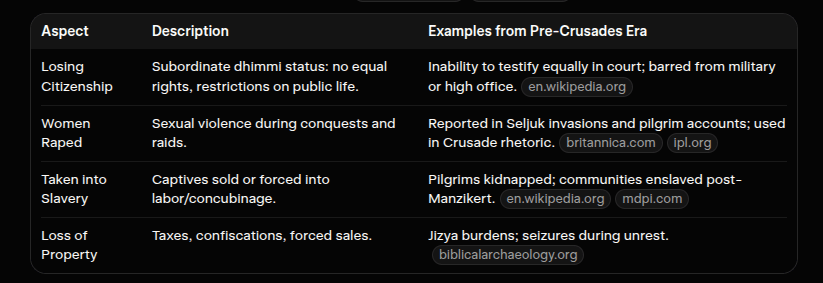
Dhimmi Status: Christians (and Jews) became “dhimmis” (protected peoples) under Islamic law, required to pay the jizya tax in exchange for limited autonomy. This system institutionalized inequality: dhimmis could not bear arms, build new churches without permission, or proselytize. They were second-class citizens, often humiliated through dress codes or public deference to Muslims. This effectively meant “losing citizenship” in the modern sense—full civic rights were denied, and status was contingent on submission. Property loss occurred via jizya (a poll tax that could be burdensome, leading to confiscations if unpaid) and occasional seizures during unrest.
Treatment varied by ruler and era. Under the Umayyad and Abbasid caliphates (661–1258), periods of relative tolerance existed, but enforcement was inconsistent. Christians faced social and economic marginalization, with some converting to Islam to escape taxes and restrictions.
Specific Hardships: Rape, Slavery, Property Loss, and Persecutions Christian accounts from the era, amplified in Crusade-era propaganda like Pope Urban II’s 1095 speech at Clermont, described escalating abuses, particularly under the Seljuk Turks who invaded Byzantine lands in the 11th century. The Seljuks, converting to Islam and conquering from Central Asia, disrupted the more stable Fatimid rule in the Holy Land, leading to harsher policies.
Losing Citizenship and Property: As dhimmis, Christians lost equal legal standing; their testimony in court was worth less than a Muslim’s, and they risked property forfeiture for perceived violations (e.g., ringing church bells too loudly). During conquests, lands were redistributed to Muslim settlers, and churches were converted into mosques. High jizya demands often forced sales of property or migration. In the 11th century, Seljuk disruptions exacerbated this, with reports of arbitrary taxes and confiscations.
Rape and Violence Against Women: Contemporary sources, including Byzantine appeals and pilgrim testimonies, alleged sexual violence during invasions and raids. For instance, during the Seljuk conquest of Anatolia (e.g., after the 1071 Battle of Manzikert), Christian women were reportedly raped amid the chaos. Urban II’s speech evoked images of Eastern Christian women being violated to stir outrage. Earlier conquests, like those in the 7th century, involved similar atrocities; Islamic legal allowances for concubines from war captives (though regulated) were cited in Christian polemics as systemic rape.
Taken into Slavery: Enslavement was common in warfare. Pilgrims to Jerusalem faced banditry, with many kidnapped and sold into slavery. During Seljuk incursions, entire Christian communities in Anatolia were enslaved or displaced. Historical estimates suggest thousands were captured, including during raids on Byzantine territories. Women and children were particularly vulnerable, often sold across Muslim markets.
These issues intensified in the decades before 1095. The Seljuks’ victory at Manzikert weakened the Byzantine Empire, threatening Constantinople and restricting Christian access to holy sites. Pilgrims reported “molestation” and oppression, including torture and forced conversions. Byzantine Emperor Alexios I Komnenos appealed to the West for aid, framing it as defense against aggression. While some historians argue these reports were exaggerated for recruitment, archaeological and textual evidence confirms periods of violence and instability.
Duration of Pacifism’s Influence on the Christian Church Before the First Crusade Early Christianity was strongly influenced by pacifism, rooted in Jesus’s teachings (e.g., “turn the other cheek” in Matthew 5:39 and “love your enemies” in Matthew 5:44). This ethos dominated the Church for its first three centuries, from Jesus’s ministry (c. 30 AD) until the Edict of Milan in 313 AD under Constantine, which legalized Christianity. During this period (approximately 280–300 years), no surviving Christian texts endorse military service or violence; Church Fathers like Tertullian, Origen, and Hippolytus explicitly opposed it, viewing war as incompatible with Christ’s commands. Christians often refused Roman military service due to idolatry and killing, leading to martyrdoms.
After 313 AD, pacifism waned as Christianity integrated with the Roman state. By 380 AD (Edict of Thessalonica), it became the official religion, and St. Augustine (early 5th century) developed just war theory to justify defensive violence. From the 4th century onward, the mainstream Church was no longer strictly pacifist, though pacifist elements persisted in monastic or fringe groups. By the time of the First Crusade (1095), about 1,065 years after Jesus, pacifism had long ceased to dominate Church policy, replaced by doctrines allowing holy wars. The Crusades marked a peak in militarized Christianity, but the early pacifist influence lingered in theological debates and minority traditions.
Notes:
1) 2 John 1:10-11: “If there come any unto you, and bring not this doctrine, receive him not into your house, neither bid him God speed: For he that biddeth him God speed is partaker of his evil deeds.”
In biblical use “G-d speed” is a solemn call to spiritual discernment.
2) Revelation 22:20: “He which testifieth these things saith, Surely I come quickly. Amen. Even so, come, Lord Jesus.”
Inevitable, imminent, evident, sudden, and unexpected. אָמֵן pronounced in English as ah-MEN means, believe.
3) Matthew 10:16 “I am sending you out like sheep surrounded by wolves, so be wise as serpents and innocent as doves.”
Sheep are incapable of defending themselves against wolves (cruel and bloody), therefore the defense is prescribed. Serpents (aware) know they are hated and shrink back while sensing danger and progress with caution when safe to not be trampled. However, this can cause a paralysis so the second creature is likened, a dove (timid) innocently progresses by flight until struck or snared by the Fowler. Some are overly cautious, timid, or lazy (sluggard) and unwilling to face danger denouncing their calling to Christ.
4) From another perspective: “Social feminization” often describes societal shifts where men are perceived or encouraged to adopt traits traditionally seen as feminine (e.g., emotional expressiveness, vulnerability, or non-traditional roles), or where cultural norms blur gender distinctions.
Social dynamics: From feminist lenses, traditional norms harm men by enforcing emotional suppression and risk-taking. Counterviews argue feminism widens a “male empathy gap,” ignoring male disadvantages (e.g., homelessness, abuse) and promoting negative masculinity narratives like “toxic masculinity,” which correlate with poorer mental health. Social media amplifies this, fostering attention-seeking and passivity.
5) Physical and relational effects: Research indicates a consistent, population-level decline in average testosterone (T) levels among men over the past several decades, independent of aging. This trend has been observed across multiple large-scale studies in various countries, including the United States, Finland, Denmark, and others. For instance, a 2021 analysis of U.S. National Health and Nutrition Examination Survey (NHANES) data from 1999 to 2016 showed that mean total T levels in adolescent and young adult men (ages 15–39) dropped from 605 ng/dL to 451 ng/dL, a roughly 25% decrease even after adjusting for body mass index (BMI). Similarly, a 2007 study of U.S. men found an age-independent drop of about 1.2% per year from the 1980s to the early 2000s, with median levels falling from 501 ng/dL in 1987–1989 to 391 ng/dL in 2002–2004. A 2025 systematic review of over 1 million subjects confirmed a negative linear trend, with an annual decline of about 0.56% persisting after controls for age, BMI, and assay methods.
6) Christopher Hitchens (April 1949 – 15 December 2011) warned that the term “Islamophobia” could be weaponized to suppress free speech, particularly criticism of Islam, by equating legitimate critique with racism. He argued that religious authorities, including priests and pastors, might be complicit in opening the door to ideological control by advocating for laws that criminalize criticism of Islam, framing it as hate speech. Hitchens feared this would enable a form of censorship disguised as tolerance, where dissenting voices—especially those challenging extremist interpretations—are silenced under the guise of protect.
He emphasized that Islam is a religion, not a race, and that conflating criticism of religious doctrine with hatred of people is dangerous. In a 2009 video, he warned that such laws could become blasphemy laws, used to punish those who challenge religious dogma, including those who question the compatibility of Sharia law with secular democracies. He cited examples like the suppression of school curricula, the renaming of sports teams, and the criminalization of Quran desecration attempts—actions he saw as signs of a growing intolerance.
Hitchens also stressed that not all Muslims are extremists, but that the ideology of some Islamic movements—particularly those promoting the imposition of Sharia—poses a challenge to liberal democratic values. He called for resistance while the right to complain and critique remains intact, urging societies to defend free expression before it is eroded by fear of being labeled “Islamophobic.”



 Thomas Aquinas (1225–1274), a Dominican friar and theologian, formalized just war theory in his Summa Theologica (Question 40, Article 1), building directly on the earlier work of St. Augustine of Hippo. Aquinas viewed war not as inherently sinful but as a potential moral act under specific conditions, rooted in natural law and Christian ethics. He argued that war could be justified if it served justice, charity, and the common good, while emphasizing that peace is the ultimate goal of human society. This framework emerged in the medieval period, amid ongoing conflicts like the Crusades, and provided a systematic way to evaluate the morality of warfare.