What Is Truth? The Concrete Stand of the Remnant Against Abstract Empire
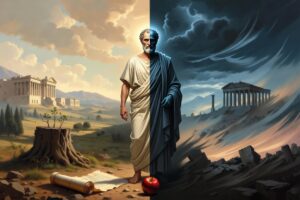
What is truth?” (John 18:38) — Caesar’s abstract query in the Gentile mode, ever disconnected from Hebrew concreteness. One side the unblinking light of covenant reality and the holy stump’s stand; the other the devouring shadow of empire, where forbidden fruit rolls into darkness. The remnant chooses the concrete: not pacifist surrender, but Shalom rooted in truth’s fight. (Isaiah 6:13; cf. the Black-Robed Regiment’s legacy.)
Standing Firm: The Unblinking Eye of the Remnant Against the Wolves of Accommodation In the prophetic atelier of Scripture, Sola Scriptura stands as the unyielding foundation where the coal-seared lips of Isaiah meet the resolve of a scattered people. Here there is no room for the dull comfort of cultural surrender. Prime Minister Benjamin Netanyahu’s recent address cuts through the fog of modern equivocation with a question as ancient as it is urgent: What would America do if bordered by armies of terrorists firing rockets across the frontier, slaughtering men, women, and children—not merely soldiers?
The query pierces the haze of performative empathy and pacifist posturing, exposing the behavioral cycle that has dogged the Jewish people across millennia. Vilified in exile, afflicted by violence, and ultimately targeted for annihilation in the Holocaust, Israel’s story is one of divine preservation amid human rage. This same ancient hatred—antisemitism—persists today, often cloaked in sophisticated theological garb. Within segments of the (universal) catholic church and beyond, replacement theology wields two-thousand-year-old texts to vilify the Jews, forgetting that Jesus Himself was a Jew, as were His disciples, the apostles, and the entire early church. Scripture records no shortage of faithless kings and wayward leaders among Israel, just as America has known presidents and policies that led the nation astray—frequently by muzzling the church into a timid pacifism or a fearful silence to preserve 501(c)(3) status.
Yet today, echoes of that same cycle resound—not only against the physical seed of Abraham but against the spiritual heirs of the faithful remnant. Under Joseph’s administration, Pharaoh in Genesis left the Egyptian priests undisturbed so long as they received their allotted portion and refrained from troubling his reign. As Scripture records, “Only the land of the priests bought he not; for the priests had a portion assigned them of Pharaoh, and did eat their portion which Pharaoh gave them; wherefore they sold not their lands” (Genesis 47:22, KJV). These priests were preserved not out of benevolence, but because they served the system—leading the people into idolatry and the worship of false gods while posing no threat to Pharaoh’s absolute power. Likewise, modern powers often tolerate a compromised clergy that offers no prophetic challenge, content to receive their tax-exempt “portion” in exchange for silence or cultural alignment. The pattern holds: vilification precedes violence, but the G-d who keeps covenant will not be thwarted.
Consider the vivid biblical picture: When the Shepherd was struck, the sheep were scattered (Zechariah 13:7; cf. Matthew 26:31). Israel, dispersed like chaff among the nations, saw even its sacred tongue reduced to a dead language—a relic of a forsaken past. Yet, in the sovereign reversal of exile, Hebrew was resurrected alongside the modern State of Israel, a stump putting forth holy shoots from the ashes. This is no mere political triumph but a testament to the G-d who keeps covenant, who gathers the outcasts and revives what man deems dead. Netanyahu’s clarion call resounds with this truth: When vilified, stand up and fight back with the truth. Israel will not lay down before evil aggressors who seek its physical extinction. The cycle demands not craven submission but covenantal resolve.
The Pacifist Church and the Lamb Led to Slaughter One cannot reflect on this without turning a prophetic eye upon the church in our day. Full of those who would have every Christian face unjust aggressors “like a lamb led to the slaughter,” many pulpits echo the siren song of unchecked pacifism. Even in America’s Revolutionary era, loyalists and pacifists abounded within the colonies, yet the Black-Robed Regiment—those Calvinist preachers in Geneva gown and martial spirit—forged the First Amendment’s Christian soul not through retreat but through bold proclamation of biblical liberty under G-d.
Today, smirking voices declare “the sword isn’t the way,” even as cultural and theological enemies encroach. This is not the costly love of the Ayin stanza (Psalm 119:121-128), where justice and neighborly protection demand unblinking vigilance despite personal prejudice. It is a double-minded dullness, a polluted garment of Isaiah 64:6 worn as virtue. Pastors and teachers, absorbed into the surrounding culture, defend a bastardized “freedom” that shelters porneia and licentiousness alongside genuine religious exercise—stretching the founders’ Protestant vision beyond recognition. What began as a safeguard for conscience and biblical virtue in a Reformation-rooted republic now treats all ideologies as interchangeable under pluralism’s broad umbrella. The church, having drunk deeply from postmodern streams for several decades and more, finds itself in a slow-flush toilet: the land has vomited out faithful witness, and what swirls in the bowl—whether politically or theologically left or right—is merely vile admixture until it is fully flushed.
Paul, Submission, and the Idols of Empire Central to this confusion stands the Apostle Paul. Many today misread Romans 13 as a call to take a knee before any emperor, Caesar, or even the ruler of this world, Satan himself. “Submit to the governing authorities,” they intone, envisioning passive acquiescence to tyranny or moral inversion. Yet Paul’s own life—imprisonments, appeals to Caesar while defying ungodly decrees, and ultimate martyrdom—belies such cowardice. Submission (hypotassō) arranges oneself orderly under G-d-ordained structures for conscience’s sake, not blind obedience to evil. It is the posture of Daniel in the lions’ den, not prostration before Nebuchadnezzar’s image.
Recall the Old Testament faithful who refused the knee: Shadrach, Meshach, and Abednego in the fiery furnace; Daniel praying toward Jerusalem despite royal edict. These were no rebels against order but servants of the Most High who distinguished the ordinance of G-d from the idolatry of the state. Barabbas led rebellion; Christ and His apostles modeled costly fidelity—truth spoken, consequences borne, without ushering in self-destruction. Short of Zealot uprising, the way of the remnant is neither suicidal pacifism nor anarchic sword-wielding, but prophetic stand: “We must obey God rather than men” (Acts 5:29).
And He brought him outside and said, ‘Look toward heaven, and number the stars, if you are able to number them.’ Then He said to him, ‘So shall your offspring be'” (Genesis 15:5, ESV). The Star of David upon the Israeli flag shines beneath the innumerable host—Abraham’s seed, scattered yet regathered, a holy remnant preserved like the stump of Isaiah 6:13. Not by human might, but by the G-d who numbers the stars and resurrects dead languages and nations. Shalom al Yisrael: the concrete promise endures against every abstract empire. שָׁלוֹם עַל יִשְׂרָאֵל
Isaiah 6:13, Jeremiah, and the Holy Stump Here Isaiah 6:13 grips with double-edged force: “And though a tenth remain in it, it will be burned again, like a terebinth or an oak, whose stump remains when it is felled. The holy seed is its stump” (ESV). Judgment falls—cities laid waste, land desolate—yet a remnant persists, the holy seed in the stump. Not every conquered people mounts defense; sometimes exile and slavery come as discipline. But willingly ushering it in, supine before aggressors? This is not faithfulness but faithlessness. Jeremiah thunders against such folly amid Babylonian conquest: the remnant left in the land after Jerusalem’s fall faced choices of submission to G-d’s ordained rod or futile resistance and further judgment. The faithful did not invite slaughter; they heeded the prophet, endured, and hoped in restoration.
The Black-Robed Regiment understood this tension. They did not fear state churches leading to tyranny (echoing Tyndale’s stand against Rome) but prized conscience within a Christian-influenced republic sustained by biblical virtue. Today’s church, culturally captive, has inverted this: defending license as liberty while scorning the vigorous defense of truth. The right thing is done for the wrong reason across parties, leaving a double-minded tongue that cuts nothing.
The Call to the Faithful Remnant Beloved, the land vomits out the lukewarm, spinning refuse in political and theological bowls until flushed. As the watchman of Ezekiel 33 warned, when a people turn to idolatry and moral corruption, “the land becomes desolate” (Ezekiel 33:28–29, ESV)—a curse upon all creation rather than the blessing it was meant to be through G-d’s faithful inhabitants (Isaiah 55:10-13 ESV). This is no mere vilification of individuals; those who dishonor the L-rd become a corporate curse that defiles community and nation alike. Yet the stump remains—the holy seed. Israel stands because it refuses submission to those who would kill it.
The church must recover the same unblinking eye: not rebellion like Barabbas, but the Regiment’s fire—preaching, publishing, and protecting virtue against wolves in sheep’s clothing, a purifying blaze like silver refined seven times in the furnace (Psalm 12:6). Pastors and teachers absorbed in culture must be called to repentance—a turning that is neither private sentiment nor vague regret, but concrete and public (Sola Scriptura cf. Isaiah 55:8-9). Like the blind guides of Matthew 23, they have led multitudes into the ditch by exchanging the sharp edge of Scripture for the dull comforts of cultural accommodation. Repentance, therefore, demands public confession of specific error: naming the idols of tolerance, sexual immorality, and political syncretism they have platformed; renouncing the double-minded teaching that confuses liberty with license; and visibly returning to the unfiltered Word—exegeting it with rigor, applying it without apology, and restoring the fear of the L-rd to their flocks. Only then can the purifying fire do its full work in their midst. G-d will accomplish His sovereign will with or without them—yet such shepherds have become obstacles He must overcome, and in many cases, the very problem the remnant is called to confront. The remnant must stand, speak truth, and fight with the sword of the Spirit.
As Netanyahu recalled the cycle, so we recall: vilification precedes violence, but the G-d of the exodus and resurrection preserves His own. Israel, called to be a light to the nations (Isaiah 42:6; 49:6), was first addressed as the older brother in the Father’s house—entrusted with the oracles of G-d, bearing the weight of covenant amid dispersion and the resurrection of both land and tongue. Yet how like the L-rd’s own lament over His vineyard: “My beloved had a vineyard on a very fertile hill… and he looked for it to yield grapes, but it yielded wild grapes” (Isaiah 5:1-2, ESV). What more could have been done for His vine? The fertile hill of promise produced bitter fruit, and the hedge was removed in judgment—yet the holy seed remains in the stump.
The prodigal church, having wandered into the far country of cultural accommodation, now rolls in the swine’s fecal matter of postmodern vomit, spinning in the slow-flush toilet of left and right, theological and political filth—unclean and double-minded. The land has spewed it out, yet the Father’s compassionate eye remains fixed on return. The Hebrew tongue lives again; so can bold, exegetical Christianity. Let the stump put forth shoots. Let the remnant—both elder and returning—stand together, not in carnal fury but in covenant fidelity. The true Light to the nations, the Shepherd of the lost sheep of Israel (Matthew 15:24; John 8:12), still calls His own out of darkness. The stakes are high; the text is alive. Wrestle, and be sharpened.