The Noahide Laws: The Moral Gravity That Distinguishes Man from Beast
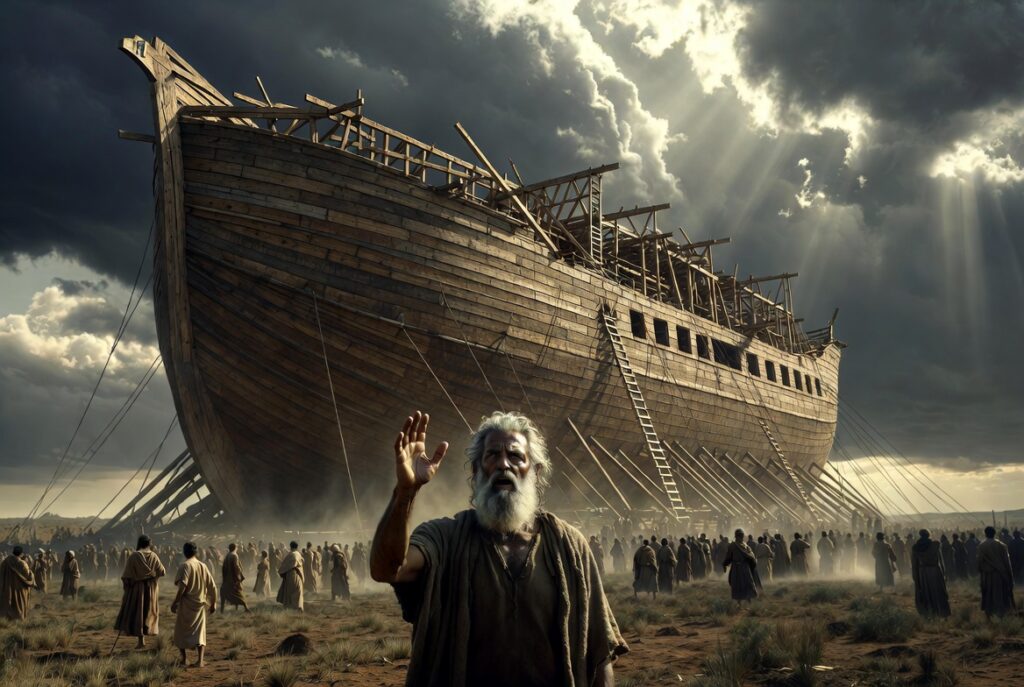
Noah, preacher of righteousness, proclaims the coming judgment while the ark rises behind him—a living call to the moral order that would later be sealed in the Noahide covenant for all humanity. The preacher was the precursor to the prophet Jonah.
The Noahide Laws: The Universal Moral Gravity of Humanness The Noahide covenant, established after the Flood, is not a narrow ethnic code, a temporary post-diluvian concession, or the property of any single religion. It is the divine reassertion of the creational order that distinguishes humanity from the beasts of the field—and it binds every human being who has ever lived, whether they acknowledge the G-d of Scripture, follow another faith, or claim no religious belief at all. These seven laws are universal because they are rooted in the nature of man as image-bearer and in the moral structure of the world G-d made.
Genesis 6 records the catastrophic background. “The LORD saw that the wickedness of man was great in the earth, and that every intention of the thoughts of his heart was only evil continually. And the LORD regretted that he had made man on the earth, and it grieved him to his heart” (Genesis 6:5–6, ESV). Humanity had so thoroughly abandoned the restraints of righteousness that the Creator Himself expressed sorrow over the race He had formed. Violence filled the earth (Genesis 6:11–13). Without binding moral law, man had already regressed toward the unchecked predation of the beasts. The Flood was the just response to that collapse.
After the judgment, G-d established a covenant not only with Noah and his sons, but with “every living creature of all flesh that is on the earth” (Genesis 9:16). The sign of that covenant is the rainbow: “I establish my covenant with you, that never again shall all flesh be cut off by the waters of the flood, and never again shall there be a flood to destroy the earth” (Genesis 9:11). The seven Noahide laws stand within this covenant framework. They are the enduring conditions under which G-d pledges never again to wipe humanity from the face of the earth by flood. These laws—prohibitions against idolatry, blasphemy, murder, sexual immorality, theft, and the eating of a limb torn from a living animal, together with the positive command to establish courts of justice—are therefore not optional religious rules. They are the structural requirements of continued human existence on the earth.
These laws are universal in the strictest sense. They apply to the “sons of Noah”—that is, to all mankind—regardless of whether a person is Jewish, Christian, Muslim, Hindu, atheist, or anything else. They do not require conversion, temple worship, or acceptance of any particular creed. They are the moral baseline written into the fabric of human nature and into the post-Flood order of the world. A society that systematically abolishes them does not become more enlightened; it begins to dissolve the very distinction between man and beast that the covenant was given to preserve.
The analogy remains precise. Gravity is not a social convention that may be voted out of existence; it is the force that keeps feet on the ground and makes ordered motion possible. Likewise, the Noahide laws are the moral gravity that grounds human nature in accountability, restraint, and justice. Remove them, and man does not ascend into a higher freedom; he falls into the horizontal plane of the beasts, governed solely by impulse, power, and immediate desire—the very condition that once grieved the heart of G-d and brought the waters upon the earth.
Idolatry: The Denial of the Creator’s Claim The first prohibition is against the worship of false gods or the reduction of the true G-d to an image of human fashioning. Scripture roots this in the opening chapters of Genesis. Humanity is created to image the one Creator (Genesis 1:26–27); to exchange that reality for “the likeness of an image of mortal man, or of birds or animals or creeping things” (Romans 1:23, echoing the biblical pattern) is to invert the order of being. Idolatry is not a private preference; it is the foundational rejection of the One who alone confers dignity upon the creature. When this law is abolished, every subsequent restraint becomes negotiable, for there is no longer a transcendent source of obligation.
Blasphemy: The Dishonoring of the Divine Name Closely joined is the prohibition against cursing or blaspheming G-d. The Talmudic tradition derives this, along with several other Noahide laws, from the language of Genesis 2:16 (“And the Lord God commanded the man…”), reading the divine “command” as establishing the seriousness of speech directed toward the Commander. Scripture consistently treats the Name with holy weight (Leviticus 24:15–16; Exodus 20:7). To abolish this boundary is to treat the Creator as an equal or lesser party who may be insulted without consequence. Such speech is the verbal counterpart of idolatry: both deny that G-d is G-d.
Murder: The Assault on the Image Genesis 9:5–6 states the matter with stark clarity: “And for your lifeblood I will require a reckoning… Whoever sheds the blood of man, by man shall his blood be shed, for G-d made man in his own image.” The prohibition against murder is therefore not merely a utilitarian rule for social stability; it is the protection of the divine image itself. Pre-Flood violence had filled the earth (Genesis 6:11–13); the covenant after the Flood reasserts that human blood is sacred because it bears the imprint of the Creator. When this law is set aside, the strong devour the weak without remaining distinction between man and the predatory beasts.
The precedent is already written in blood in Genesis 4. Cain rises up against his brother Abel and kills him—the first recorded act of human violence, and the archetypal assault on the image of G-d. Abel’s blood does not merely soak into the ground; it cries out to the L-rd from the soil (Genesis 4:10). The cry is not abstract sentiment. It is the protest of the image itself against its own desecration. G-d’s interrogation of Cain—“What have you done?”—and the subsequent curse upon the ground that had received the blood establish the moral gravity that Genesis 9 later codifies for all humanity. Murder is not simply the taking of life; it is the willful erasure of a living witness to the Creator. The one who sheds blood attacks not only his neighbor but the One whose likeness the neighbor bears.
Even in judgment, the narrative refuses the pure logic of the beasts. G-d places a mark on Cain so that no one who finds him will kill him (Genesis 4:15). The protection of the murderer does not cancel the sacredness of the victim’s blood; it underscores that the image remains inviolable even in the one who has assaulted it. The Flood later reveals what happens when this restraint is abandoned on a civilizational scale: “the earth was filled with violence” (Genesis 6:11). The post-Flood covenant therefore does not invent the prohibition; it restores and universalizes the verdict already pronounced over Cain. Human blood requires a reckoning because it is not mere biological fluid. It is the life of the image-bearer. To treat it as disposable is to treat the Creator’s own imprint as disposable—and to slide, inevitably, toward the predation of those who know no such distinction.
Sexual Immorality: The Regression of Desire The prohibition against illicit sexual relations—adultery, incest, bestiality, and homosexual acts in the classical enumeration—guards the creational order of one-flesh union (Genesis 2:24). The pre-Flood narrative supplies the paradigmatic warning. “The sons of God saw that the daughters of man were attractive. And they took as their wives any they chose” (Genesis 6:2). The Nephilim episode is not mere ancient etiology; it is the portrait of power and desire unconstrained by covenantal boundaries. Sexual immorality is the refusal to submit appetite to the form G-d established for human flourishing. When this restraint is abolished, men become indistinguishable from animals that take what they can seize. Passion is no longer ordered toward covenant and generation; it becomes the restless pursuit of possession, reducing persons to objects of consumption. The result is not liberation but regression—the return of the strong to the taking of the weak that marked the days before the Flood.
Theft: The Violation of Stewardship The prohibition against robbery and theft protects the legitimate boundaries of possession and labor. Humanity was given dominion and the mandate to work the garden (Genesis 1:28; 2:15). Theft dissolves the distinction between mine and thine, reducing social life to the law of the pack, where the stronger simply takes. In the absence of this restraint, trust collapses, and communities dissolve into mutual predation.
Eating the Limb of a Living Animal: Cruelty as a Bestial Mark (Total Depravity, Unchecked Limitations, and Regression). Genesis 9:4 states: “But you shall not eat flesh with its life, that is, its blood.” Rabbinic tradition understands this to include the prohibition against ever min ha-chai—tearing a limb from a living creature and consuming it. The point is not merely dietary fastidiousness; it is the rejection of unnecessary cruelty. A beast may seize living prey and begin to feed while the victim still struggles. Man is forbidden to do likewise. The law insists that even in the taking of life for food, a qualitative difference must remain: humanity does not inflict avoidable suffering for the sake of appetite. To abolish this boundary is to erase the last formal distinction between human predation and animal savagery. The one who tears living flesh has already accepted the ethic of the field.
Courts of Justice: The Institutionalization of Accountability The final command is positive: societies must establish courts of justice to enforce the preceding laws. Without adjudication, the other six remain private aspirations rather than public reality. Justice is the communal expression of the image of G-d, who is the righteous Judge of all the earth (Genesis 18:25). When courts are corrupted or abolished in favor of raw power, the Noahide framework collapses into the chaos that preceded the Flood.
These seven laws are the shape of human nature as G-d ordered it after the judgment of the waters. They mark the boundary between the one who bears the image and the beasts that do not. The rainbow remains the sign that G-d will not again destroy the earth by flood; the laws remain the condition under which humanity may continue to inhabit that earth without descending into the violence that once filled it and grieved the heart of its Maker. They are universal. They do not depend on religious affiliation or the lack of it. They stand as the enduring witness that the Creator has not abandoned the distinction He Himself established—and that He has bound Himself by covenant never again to wipe away a humanity that, however imperfectly, still lives under these restraints. To treat them as dispensable is to treat gravity as dispensable.
A common objection among some Christians is that any attempt to keep law is doomed, since “all have sinned and fall short of the glory of God” (Romans 3:23) and no one is justified by works of the law. That truth stands. The Noahide laws were never a ladder for fallen man to climb into heaven. They are the floor that keeps the human race from dropping straight into the abyss. They do not save. They merely preserve the possibility of a society that still looks human. To dismiss them because perfect obedience is impossible is not humility—it is evasion. Beasts do not keep these laws because they cannot. Men who refuse them are not therefore reduced to beasts. They are more dangerous. The animal acts from instinct. The man who deliberately discards the restraints against idolatry, bloodshed, sexual chaos, theft, cruelty, and injustice retains the intelligence of the image while rejecting its moral shape. He becomes something worse than a beast: a predator who knows the difference between right and wrong and chooses the latter with calculated skill. The laws remain the boundary. Treat them as optional and you treat gravity as optional. The experiment does not produce flight. It produces free fall. And those who accelerate the fall are not merely lawless—they are more cunning than the beasts of the field.
Soli Deo Gloria Wit
Note
Noah (נֹחַ / Noach) is pronounced roughly NO-akh (or No-ach), with the stress on the first syllable and a guttural, throaty kh/ch sound at the end—like the “ch” in the German name Bach or the Scottish “loch.” English “Noah” softens and anglicizes it, dropping that final chet. The name comes from the root nuach (נוח), related to rest, relief, or comfort. In Genesis 5:29 Lamech names him with the hope that “this one will give us rest (yenachmenu) from our work and from the toil of our hands.”
The consonants of Noah are נח (nun–chet). Reverse them and you get חן (chet–nun) = chen, the ordinary Hebrew word for grace, favor, or acceptance. Genesis 6:8 makes the wordplay explicit: “But Noah found grace (chen) in the eyes of the LORD.” So the name itself is chen written backward. Many Jewish and Christian readers have long noticed this: Noah is a kind of mirror or inversion of grace. The man whose name means “rest” is the one upon whom G-d’s favor rested, and that favor is what carried him through the judgment.
The reversal does not change the physical letters; it simply flips their order, producing the word for the very grace that kept Noah and the ark afloat. The ark (tevah) itself becomes the concrete vessel of that grace—sealed, lifted by the waters, and brought to rest. In that sense the name “floats” on the same principle: rest (noach) is sustained by the reversed form, grace (chen). The letters that spell the man who rests are the same letters that spell the favor that keeps him from sinking.
What began as a father’s hope for relief from cursed toil is thereby turned. The name that looked forward to rest is revealed as grace written backward—and that unmerited favor is what finally grants the rest. The judgment that should have swallowed everything becomes the flood that lifts the ark. In the simple flip of two letters, what was spoken in the language of human exhaustion is made into something of pure grace.