Not the Same Flood: Walking Isaiah 28 Until Ariel Whispers
Chapter 28 ends with a door. What crouches there is not a slogan. The next woe has a name: Ariel.
Isaiah 28 KJV
Woe to the crown of pride, to the drunkards of Ephraim, whose glorious beauty is a fading flower, which are on the head of the fat valleys of them that are overcome with wine! Behold, the Lord hath a mighty and strong one, which as a tempest of hail and a destroying storm, as a flood of mighty waters overflowing, shall cast down to the earth with the hand. The crown of pride, the drunkards of Ephraim, shall be trodden under feet: and the glorious beauty, which is on the head of the fat valley, shall be a fading flower, and as the hasty fruit before the summer; which when he that looketh upon it seeth, while it is yet in his hand he eateth it up.
In that day shall the Lord of hosts be for a crown of glory, and for a diadem of beauty, unto the residue of his people, and for a spirit of judgment to him that sitteth in judgment, and for strength to them that turn the battle to the gate.
But they also have erred through wine, and through strong drink are out of the way; the priest and the prophet have erred through strong drink, they are swallowed up of wine, they are out of the way through strong drink; they err in vision, they stumble in judgment. For all tables are full of vomit and filthiness, so that there is no place clean.
Whom shall he teach knowledge? and whom shall he make to understand doctrine? them that are weaned from the milk, and drawn from the breasts. For precept must be upon precept, precept upon precept; line upon line, line upon line; here a little, and there a little: for with stammering lips and another tongue will he speak to this people. To whom he said, This is the rest wherewith ye may cause the weary to rest; and this is the refreshing: yet they would not hear. But the word of the Lord was unto them precept upon precept, precept upon precept; line upon line, line upon line; here a little, and there a little; that they might go, and fall backward, and be broken, and snared, and taken.
Wherefore hear the word of the Lord, ye scornful men, that rule this people which is in Jerusalem. Because ye have said, We have made a covenant with death, and with hell are we at agreement; when the overflowing scourge shall pass through, it shall not come unto us: for we have made lies our refuge, and under falsehood have we hid ourselves: therefore thus saith the Lord God, Behold, I lay in Zion for a foundation a stone, a tried stone, a precious corner stone, a sure foundation: he that believeth shall not make haste. Judgment also will I lay to the line, and righteousness to the plummet: and the hail shall sweep away the refuge of lies, and the waters shall overflow the hiding place. And your covenant with death shall be disannulled, and your agreement with hell shall not stand; when the overflowing scourge shall pass through, then ye shall be trodden down by it. From the time that it goeth forth it shall take you: for morning by morning shall it pass over, by day and by night: and it shall be a vexation only to understand the report. For the bed is shorter than that a man can stretch himself on it: and the covering narrower than that he can wrap himself in it. For the Lord shall rise up as in mount Perazim, he shall be wroth as in the valley of Gibeon, that he may do his work, his strange work; and bring to pass his act, his strange act. Now therefore be ye not mockers, lest your bands be made strong: for I have heard from the Lord God of hosts a consumption, even determined upon the whole earth.
Give ye ear, and hear my voice; hearken, and hear my speech. Doth the plowman plow all day to sow? doth he open and break the clods of his ground? When he hath made plain the face thereof, doth he not cast abroad the fitches, and scatter the cummin, and cast in the principal wheat and the appointed barley and the rie in their place? For his God doth instruct him to discretion, and doth teach him. For the fitches are not threshed with a threshing instrument, neither is a cart wheel turned about upon the cummin; but the fitches are beaten out with a staff, and the cummin with a rod. Bread corn is bruised; because he will not ever be threshing it, nor break it with the wheel of his cart, nor bruise it with his horsemen. This also cometh forth from the Lord of hosts, which is wonderful in counsel, and excellent in working.
Walk. Do not skim.
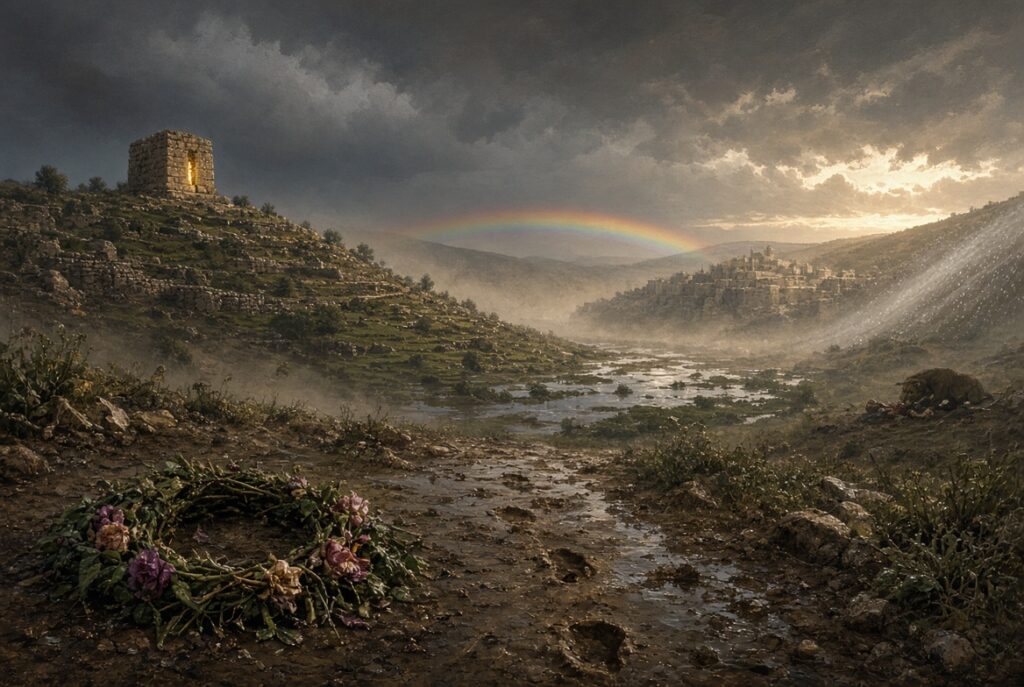
The son of Amoz is already moving. Stay on the ridge and you will only catch the slogan—woe, stone, remnant—words worn smooth like coins. Come down. The path is wet. Your sandal sinks. The wreath that was a city’s pride is not an idea hanging in air. It is in the ditch: petals glued to clay, flies on sweetness already turning. That smell is Ephraim’s crown after the feast.
Do not skip a stone across this chapter. Skipping a stone is not walking on water. It is the cheap trick of staying dry: tap, tap, tap, far bank, dry shins, no memory of depth. Isaiah will not give you that. He wants cold at the knee. He wants the wreath under the heel. He wants the wine-sour room where the men who were supposed to see cannot keep their feet—watchmen gone blind in the cup, dogs that will not bark, posted at the wall and already on the floor.
What the chapter actually does with water Isaiah 28 talks like a flood and then refuses to be Genesis 7.
Watch the verbs. A mighty one comes “like” hail, “like” a destroying storm, “like” overflowing waters—and he casts a crown to the earth. Later, hail sweeps a refuge of lies; waters overflow a hiding place. An overflowing scourge passes through, seizes, returns morning by morning. Terror is in hearing the report. Samaria can be swallowed like a first fig. Judah can still be addressed. The hiding place can be named because it still exists.
That is not “the world went under.” That is water with a target, a path, and a leftover landscape. The chapter itself distinguishes image from method: force as flood, not flood as erasure of all flesh.
Now set beside it the older scene the Bible already gave you—not because Isaiah 28 quotes the bow, but because you already know the difference when you hear it. Once the deep broke and the windows opened and mountains disappeared. Afterward a bow in the cloud: never again that destruction of all flesh by waters. Isaiah 28 does not reopen that classroom. It uses flood-talk the way a prophet uses fire-talk: to name an army, a siege, a lie that cannot keep the weather out. Cry water here and you are not calling for a bucket. You are naming what is already coming under the door. The fire-cry waits in the next woe, when Ariel is visited with flame. If someone tells you this chapter is Noah again, the text will not carry that weight. Deliver the distinction from what is on the page: local, repeated, aimed, survivable for a remnant, fatal for a wreath.
The men who stagger in vision Stay in the room.
These are priests and prophets. They reel. They are swallowed by wine. They err in vision. They stumble in judgment. The table is full of vomit; there is no place clean. Hold the camera there. A holy hand should have steadied a cup. It knocked the cup over.
They are offered rest—“This is the refreshing”—and it sounds like a child being drilled: precept upon precept, line upon line, here a little, there a little. So they go backward, break, are snared, are taken. Spiritually drunk, here, is not only the bottle. It is the inner ear that will not hold a line. Rest sounds like an insult. A treaty with death feels like policy. A judge who cannot stand will drag a crooked measure across a people. A seer who slurs will sign with the grave and call it wisdom.
The chapter’s opposite is not a temperance pledge. It is the one who trusts the cornerstone and is not flung into panic—eyes clear enough to take the line and the plummet.
The bed is too short. The blanket is too narrow (Isa 28:20). You cannot stretch out on the treaty. You cannot cover yourself with the lie. That is the roof they bought. It does not fit a human body.
Lies for a roof Jerusalem’s scoffers watch the north go under and write insurance. Covenant with death. Agreement with Sheol. When the overflowing scourge passes through, it will not reach us. Lies for refuge. Falsehood for a hiding place.
Then a stone is laid in Zion—tested, precious, a foundation. The one who trusts it is not flung into panic. Justice is the measuring line. Righteousness the plummet. Hail takes the roof off the lie. Water finds the crawlspace. The pact with death does not stand when the scourge comes through. A refuge can be swept because there was a refuge. A hiding place can flood because there was a place. Demolition of a shelter—not deletion of a world.
Strange work He will rise as at Perazim, where He broke through for His own like a breach of waters. He will stir as in the valley of Gibeon, where hail finished men on the run. Same arsenal. Different desk. That is why the work is called strange, alien. The force is familiar. The direction is not. He does not need a second global drowning to make the point. He turns the old victories around and aims them at the household that mocked rest.
What the Farmer delivers Give ear. A plowman does not plow all day in order to plow. He breaks clods, then he sows: some seed cast, some placed, wheat in rows, barley in its strip, spelt at the edge. Fitches do not meet the sledge. Cumin does not meet the cart-wheel. A staff. A rod. Bread-grain is bruised enough to become bread, not ground into powder that cannot be baked. He does not thresh forever. This, the chapter says, comes from the L-rd of hosts—wonderful in counsel, excellent in working.
G-d is not one instrument. He matches tool to crop. Severity has a stop. Preparation is not harvest. If you want the older flood in the conversation, set it after this as contrast. Genesis closed one method for all flesh. Isaiah 28 shows another pattern for a people: measured, varied, ended when more of the same would ruin the grain. The Farmer does not need the rainbow to be true. He needs you to watch him refuse the same stick on cumin and on wheat.
The door that opens to Ariel Chapter 28 does not dump you in a field and walk off. It leaves you at a door.
An older sentence waits there, from the first family, not from Isaiah’s mouth: sin is crouching at the door (Gen 4:7). Desire is for you. You must master it. Do not picture a house-cat. Picture a tiger in the threshold—shoulders low, tail still, eyes on the latch. Not leaping yet. Crouched.
The thing does not arrive as one honest color. It is barred: gold laid over night. The fading wreath still shows its pinks in the mud; the wine still looks like feast; the treaty still reads like shelter. Stripe, then shadow, then stripe again—beauty and bruise in the same hide. Drunk vision loves that coat. It counts the bright band and calls the pattern glory, and never weighs the shoulders.
The short bed, the narrow blanket, the pact with death—that is not the end of the lesson. That is the tiger taking its color into the doorway. Master it, or the latch learns your hand.
The next woe is the door swinging. Ariel, Ariel—the city where David camped (Isa 29:1–8). Add year to year. Let the feasts come around. He will still distress her. He camps. He raises mounds. She is brought down. Speech comes out of the ground. The voice is a whisper from the dust—thin, dry, almost a whistle, what a proud throat sounds like when the air is gone. Lion-of-G-d, hearth-of-G-d, mouth in the dirt. Snapshot of attack: dust on the tongue.
Then the frame reverses inside that same oracle: the multitude against her becomes fine dust and chaff. Thunder, earthquake, whirlwind, fire. Nations that came to eat wake like a hungry man from a dream of bread—mouth full of nothing. She is lowered first. She is not erased from the map.
The tiger at 28’s door was the warning. Ariel is what the city sounds like when the latch has already moved.
Head down. The crunch. Two chapters later the same book will not give you a lion on a banner. It gives a young lion that already has the prey (Isa 31:4). Head down. Jaws on bone. First the wet work, then the dry crack. Shepherds shout, a whole band. He does not lift his head. He does not slink. The noise is weather. So the L-rd of hosts comes down for Mount Zion and for its hill. No promise that the bone is sweet. A promise that shouting will not move the head.
Walk out the way you came. Feet still wet. Chapter 28 has given you what it will give: water that behaves like an army, not like a second unmaking of the earth; eyes that cannot hold a vision; a stone that does not panic; a Farmer who changes tools because cumin is not wheat; a door with a tiger in it; a city made to whisper; a Lion who keeps His head down. It does not graduate you into a long-legged bird posed on red mud—pretty silhouette, clean ankles, caption ready, mincing like the daughters of Zion with their tinkling feet (Isa 3:16)—while the real path goes on sucking at the sole. That bird is a red herring with excellent posture. Do not skip the stone. Put your foot in the mud and stay with the son of Amoz until the whisper and the crunch are both in the ear.