They Knew Not What They Did: Tyndale at the Stake, Apostolic Succession Versus Doctrine, and the Dim Mirror That Still Requires the Book
“We have all become like one who is unclean, and all our righteous deeds are like a polluted garment” (Isaiah 64:6)—even those who knew not what they did, and did what they thought was right.
We have all become like one who is unclean, and all our righteous deeds are like a polluted garment. (Isaiah 64:6) Father, forgive them, for they know not what they do. (Luke 23:34)
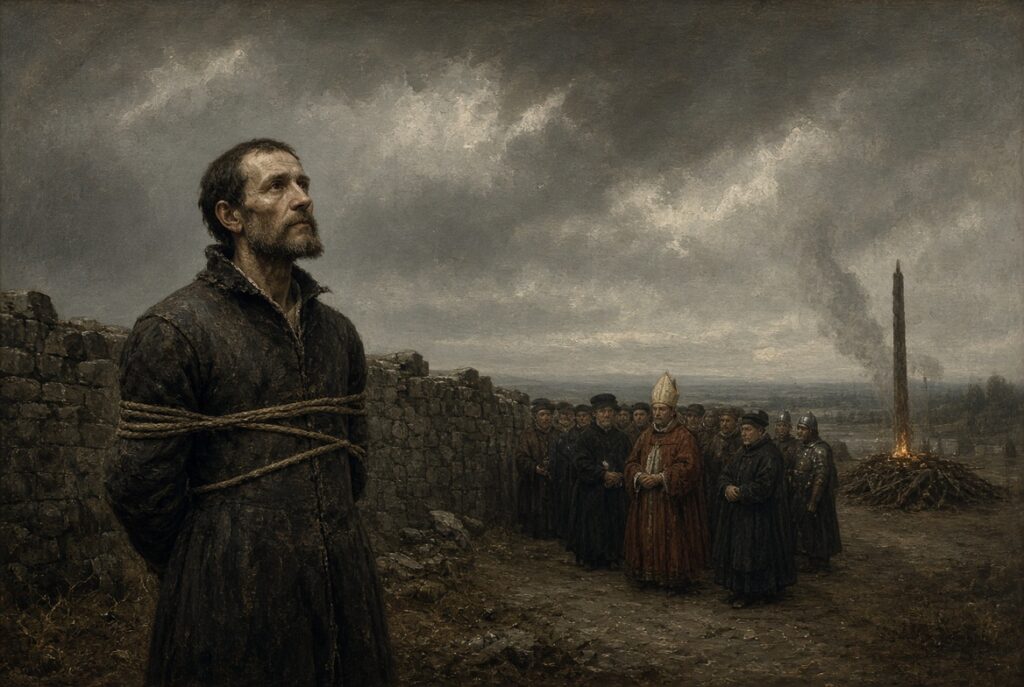
The men who lit William Tyndale did not think they were villains in a later Protestant pageant. They thought they were keeping the house. That is the point of the rags. Isaiah does not say the pagan’s crimes are filthy. He says our righteous deeds—the ones we would put on a résumé for heaven—are a polluted garment. The translators of the English Bible were not burned by cartoon sadists. They were burned by men who had a chain, a chair, a school, and a conscience they believed was clean.
The Chain Is Not the Doctrine Apostolic succession, as Rome and some Anglicans press it, is the claim that authority travels by hands: the Twelve laid hands, those men laid hands, and the present bishop sits in a line that cannot be broken without unchurching the church. Scripture does not teach that mechanism. Matthias replaces Judas so the Twelve remain Twelve while the foundation is still being laid (Acts 1; Ephesians 2:20). Paul rebukes Peter to his face when the gospel is at stake (Galatians 2:11–14). The test is never “who touched whose skull” but “what did the apostles actually preach.”
Succession of office without succession of doctrine is a costume. A man can sit in Peter’s chair and deny justification by faith. A man can sit in no chair at all and preach the same Christ Paul preached. The fallacy is appeal to authority dressed as piety: because the institution is old, the premise must be true. Age is not inerrancy. Semitic guilds, medieval schools, and modern seminaries have all been wrong in the same breath—educated into error on a false first principle, or prejudiced into giving a favorite teacher the benefit of the doubt when the text will not.
That is not a sneer at learning. Tyndale was learning. He was a Cambridge and Oxford man who then put the Word into the plowboy’s hand. The benefit of the layman handling Scripture is that no guild owns the text. The disadvantage is that a man can cut himself on the sword he was never taught to hold. Both dangers are real. Neither is solved by locking the book.
Tyndale, the Plowboy, and the Market in Seats William Tyndale’s work was not a hobby. He translated so that “a boy that driveth the plough” would know more of Scripture than the clergy who forbade it. He gave English a Bible that still lives in our ears. He died at Vilvoorde in 1536 after strangling and fire—the ordinary means of a church that had learned to buy and sell the seats from which it then condemned the translator.
Total depravity is not a slogan about “those people.” It is the confession that every member of the visible church can be corrupted by the same flesh: the man who buys a benefice, the man who sells one, the man who lights the bundle because the bishop said the vernacular was sedition. “They know not what they do” is not a free pass. It is the diagnosis. They did what they thought was right. Isaiah still calls the garment filthy.
Self-learned readers are not automatically saints. Academia is not automatically a whore. Mystics are not automatically either, and they are not the same species as the autodidact. The self-taught man still claims to be reading the Book; his danger is an unexamined premise and no one in the room to make him bleed for it. The mystic claims a second room: interior light, rapture, “union,” a word that arrives without a chapter and verse that can be checked. That is closer to gnosis than to Tyndale’s plowboy. A school debate can force a man to check his work. The canon can do the same without tuition—immediate context, then the whole counsel—tota Scriptura—until verses that look like enemies are forced to shake hands. If they will not, the reader has smuggled a premise into the text. If the mystic will not let the text sit in judgment on the vision, he has smuggled a second bible into the heart. Experience is not an enemy of Scripture when it is the fruit of the Word applied. Experience that will not submit to the Word is just the inner chair.
Gnosis: The Other Chair, the Inner One The chair is not the only rival to the Book. There is also the secret. Gnosticism—gnōsis, knowledge that saves because the knower has it—did not wait for the Middle Ages to invent a magisterium. It walked into the first-and second-century churches wearing Christian names and offering a shortcut around the public Word.
A lamp is not lit to be put under a basket (Matthew 5:15; Luke 8:16). The saying is not a slogan for branding. It is a fork in the road. Either the secrecy destroys the discipleship—because a disciple is a witness, and a witness who will not speak has already denied the Master—or the discipleship destroys the secrecy, because the Word that saves is the Word that must be preached from the housetops (Matthew 10:27). Gnostic religion chooses the basket and calls it maturity. The gospel chooses the stand and calls the dark a place to shine, not a vault for initiates.
Scripture does know a depth that is not obvious and is not equally obtainable by every faculty of every man. Job already said it: coral and crystal cannot be mentioned; the price of wisdom is above pearls; it is not found in the land of the living by the miner who can map the veins of the earth (Job 28:12–20). Paul can speak of a wisdom of G-d en mystēriō—hidden, decreed before the ages—and still insist that it is now revealed through the Spirit in words taught, not in a private password (1 Corinthians 2:7–13). Hidden does not mean hoarded. The treasure hidden in a field is hidden so that a man will sell all he has to buy the field, not so that a guild can rent the map (Matthew 13:44). The pearl of great price is not a cipher for the few. It is a cost for the one who has seen its worth (Matthew 13:45–46). The Gnostic hides knowledge from the neighbor. The kingdom hides treasure in the world so that the neighbor might stumble on it, sell what he cannot keep, and own what he cannot invent. One “hidden” starves the church. The other feeds it—at the price of the whole self, not the price of an inner circle.
The problem is not that Christians think. Paul reasons in the synagogue. Isaiah summons, “Come now, let us reason together” (Isaiah 1:18). The problem is autonomous reason: the mind that will not sit under what G-d has said, and therefore must invent a higher story to explain why the plain story is for peasants. Gnostic systems—Valentinian, Sethian, Basilidean, and the swarm Irenaeus catalogued—typically ran the same engine: a lesser maker botched the material world; spirit is trapped in flesh; salvation is escape by inside information; the G-d of Israel is at best a demiurge. Matter is the accident. The cross becomes a symbol or a trick. The resurrection of the body becomes an embarrassment. The Old Testament becomes a problem to be solved by a better myth.
That is not “influence” in the polite academic sense. It is an opponent that learned the church’s vocabulary. Simon Magus already tried to buy the Spirit (Acts 8). The pastoral letters already warn against myths, endless genealogies, and the knowledge that puffs up (1 Timothy 1:4; 6:20—tēs gnōseōs tēs pseudōnymou, “the knowledge falsely so called”). 1 John tests the spirits by the flesh of Christ: whoever will not confess Jesus Christ come in the flesh is not of G-d (1 John 4:2–3). Colossians refuses the hollow philosophy that treats angels and austerities as a ladder past the Head (Colossians 2:8–23). The apostles were not waiting for Nag Hammadi to name the disease. They named it while it was still in the foyer.
By the second century the disease had libraries. Irenaeus of Lyons wrote Against Heresies not because he loved inventories but because the Gnostic teacher claimed a pipeline the bishop did not have: secret tradition from a favorite apostle, reserved for the mature. Here the two fallacies shake hands. Apostolic succession of office says the line of hands guarantees the faith. Gnostic succession of insight says the line of initiates guarantees it. Both treat the public Scriptures as insufficient for the ordinary saint. Both make the plowboy wait in the hall.
The church’s answer—imperfect in practice, right in principle—was not “stop thinking.” It was: the rule of faith is the faith already preached, the Scriptures already read aloud, the Christ who actually suffered under Pontius Pilate. Tertullian asked what Athens had to do with Jerusalem when Athens wanted to baptize the gospel into a system the apostles never taught. The later church would sometimes forget that question and baptize Plato anyway. That forgetfulness is how gnosis survives a council: not always as a named sect, but as the habit of trusting the interior light, the academic key, the “deeper reading” that no longer has to survive the next verse.
Reason under Scripture is a servant. Reason over Scripture is a demiurge with tenure. The dim mirror of 1 Corinthians 13 is not an invitation to invent a clearer mirror in the self. It is a confession that we know in part from what has been given, until we know face to face. Gnosis promises face to face now, for a fee of pride. Sola Scriptura tells the proud man to open the book the plowboy can also read.
Hermeneutics Is Not a Luxury Course Hermeneutics is the disciplined art of saying what the text said, not what the guild needs it to say. Exegesis draws out. Eisegesis reads in. The five solas are not a fifth wheel on the carriage; they are the rails:
Sola Scriptura: the final court. Tradition may report; it may not overrule.
Sola fide, sola gratia, solus Christus: the gospel the successionists so often fence with sacraments and chairs.
Soli Deo gloria: the end of buying seats.
The five points of Calvinism are not a second Bible. They are a fence against the same pride that lights translators: man is not neutral, grace is not a cooperative project, the Shepherd loses none of His sheep. An exegesis that “violates” those rails usually does so because it began with a different anthropology.
How to Check the Work
Narrow context. Who is speaking, to whom, in what argument? 1 Corinthians 13 is not a wedding poem first. It is Paul telling a gift-drunk church that love outlasts the partial tools they were treating as trophies.
Book type. Law binds and blesses a covenant people. Wisdom observes the grain of the world under heaven. Apocalyptic pulls the veil and uses pictures that must be read as pictures. Prophecy prosecutes and promises. Epistle applies the finished work to congregations that still sin. Treat a proverb like an apocalypse and you will invent a slot machine. Treat an apocalypse like a proverb and you will date the end of the world from a microwave clock.
Broad context / analogia fidei. No prophet contradicts a prior prophet. No verse, rightly read, contradicts another. If two texts seem to quarrel, the interpretation is the defendant, not the canon. Inerrancy is not a mood. It is the confession that the Author does not stutter.
The solas as negative tests. If the reading makes Scripture a co-equal with a living magisterium, it has left sola Scriptura. If it makes faith a work that completes grace, it has left sola fide. If it makes the present age already “face to face,” it has skipped the battleground.
Grudem, the Partial, and the Perfect Wayne Grudem reads 1 Corinthians 13 as the timeline of how humans acquire spiritual knowledge across redemptive history—not as a footnote about which charisma died in A.D. 100, and not as a charter for perpetual prophecy that adds sentences to the closed book.
Paul says we know ek merous—in part—and prophesy in part (1 Corinthians 13:9). The whole era between the first and second comings is fragmentary. The mirror is bronze, not glass: dark, warped, useful, never final (13:12). Preaching, teaching, and whatever “insight” a man claims today still pass through a human capacity that cannot take the full weight. Complete clarity is not on the syllabus of this life.
“The perfect” (to teleion) is not the bound canon landing on a table. Grudem is right to refuse that squeeze. The canon is closed and sufficient now; “the perfect” in this paragraph is the eschatological arrival—Christ seen prosōpon pros prosōpon, face to face, the language Moses and Jacob already used for unmediated encounter (Genesis 32:30; Exodus 33:11). The mode changes: from mediated words and partial glimpses to direct presentation.
The child/man analogy is not “the early church was childish until it got a Bible.” The whole earthly life of the believer is childhood. When the perfect comes, “I shall know fully, even as I have been fully known.” We do not become omniscient. We lose the fog—bias, limitation, confusion—so that the knowing is clear the way His knowing of us is already clear.
That is cessationism without embarrassment. The revelatory foundation was laid by apostles and prophets (Ephesians 2:20). The sign-gifts that authenticated that foundation are not the church’s standing toolkit for adding chapters. What remains is the ordinary means: the Word already given, preached, read, sung, obeyed. The Spirit still illumines. He does not dictate a seventy-seventh book to a man with a microphone.
Some have skipped to the end. They talk as if the veil were already pulled back, as if every impression were a prophecy, as if the battleground were a prize ceremony. That is how you hand the enemy a participation trophy. We are not face to face. We are in part. The transformation is through Scripture in this age—renewing the mind, not bypassing it (Romans 12:2). Love is the thing that does not cease while the partial tools do their temporary work. Love is not a substitute for doctrine. It is what doctrine produces when the King has cancelled the unpayable debt and the servant stops choking his brother over lunch money.
The Battleground Is the Book Tyndale’s ashes do not make every Anglican a murderer or every Roman bishop a fool. They make a warning: power seated in the church can still wear filthy rags and call them vestments. The layman with an open Bible can still butcher a verse and call it liberty. The seminary can still catechize a false premise until it feels like air. The initiate can still call his private light gnosis and treat the public Word as milk for the unenlightened. The only court that sits above the chair, the guild, and the inner secret is the text that does not contradict itself when it is read as one Book, in its kinds, in its contexts, under the same Spirit who authored it. Genesis 1:1–2 is a standing test case: its meaning is recovered only when the author’s intent is pursued in its own exegetical setting.
We know in part. We do not therefore shrug. We check the work. We harmonize what looks contrary. We refuse to baptize a chair, a degree, or a “word from the L-rd” that cannot survive the next chapter. The plowboy was not given the Bible so he could invent a private pope. He was given it so that no private pope could keep him from the King.
The fire at Vilvoorde was real. The garment is still filthy when we trust the deed instead of the Word. The mirror is still dim. The perfect has not come. Until it does, the school of Isaiah is not a faculty lounge. It is a dojo with an open canon and no participation trophies.