Seventy Times Seven and the Loan Shark Who Forgot the Ledger: Peter’s Calculator, the King’s Talent, and Why Mercy Still Puts Wickedness on the Scale
The king’s books are open. Ten thousand talents sit on one side of the beam; a throat sits on the other. Mercy cancelled the first debt. It did not cancel the scale.
Peter brought a calculator. The King brought a ledger that already had Peter’s name in the red. My friend Wimpy—yes, that Wimpy, the one who treats “I’ll gladly pay you Tuesday for a hamburger today” as a sacrament—keeps tapping my shoulder. Same request. Same Tuesday that never arrives. Same belt that keeps needing a new hole. Peter wanted a number so the ledger would close. Wimpy wants a hamburger so the ledger never opens. Matthew 18 is what happens when the King cancels the first ticket and the man still uses your throat as a drive-thru.
Peter is not the village idiot of the Gospels. He is the man who has just heard the church-discipline sequence—go privately, take two or three, tell it to the assembly—and he wants the fine print. “Lord, how often will my brother sin against me, and I forgive him? As many as seven times?” (Matthew 18:21). Seven is not random. Seven is completeness in the holy tongue: creation’s week, the sabbath pulse, the righteous man who falls seven times and rises (Proverbs 24:16). Peter is trying to be generous. He has already doubled the street-smart rabbinic limit.
The Brightest of Babylon Did Not Stop at Four Because Four Was Cute Later Talmudic discussion is not Matthew’s source, and we will not pretend Yavneh sat in the room with Peter. Yavneh (יַבְנֶה)—the coastal academy Yochanan ben Zakkai built after the Temple burned—is where the sages gathered the wreckage of a lost altar and kept teaching. That is after 70. Peter is asking his question decades earlier, in the hearing of a living Temple and a living King. The dates do not touch. The pattern still matters.
Amos already uses the formula “for three transgressions… and for four” as the point where patience is no longer patience (Amos 1–2). In Yoma (יוֹמָא, “The Day”—the tractate on Yom Kippur) the sages treat three as the line that turns an isolated stumble into habit—chazakah, a legal presumption. The offender must come and appease. He is not handed a mute hug. He asks; in the later ruling he names the wound unless naming it would strip the brother naked. After three honest pleas, the one who still will not grant mechilah—pardon, release of the claim—becomes the sinner, unless he withholds to humble a stiff neck, not to nurse a grudge. Four is the symbolic “enough already” of a world that still believes numbers can keep score. It is not a license to forgive as if nothing happened and no one need be taught. Yoma wants the debt faced. Jesus will not let the face become a calculator.
Peter offers seven. Jesus does not compliment the upgrade. He detonates it. Then He (the Atonement) tells the story that makes the number bleed:
Then Peter came up and said to him, “Lord, how often will my brother sin against me, and I forgive him? As many as seven times?” Jesus said to him, “I do not say to you seven times, but seventy-seven times.“
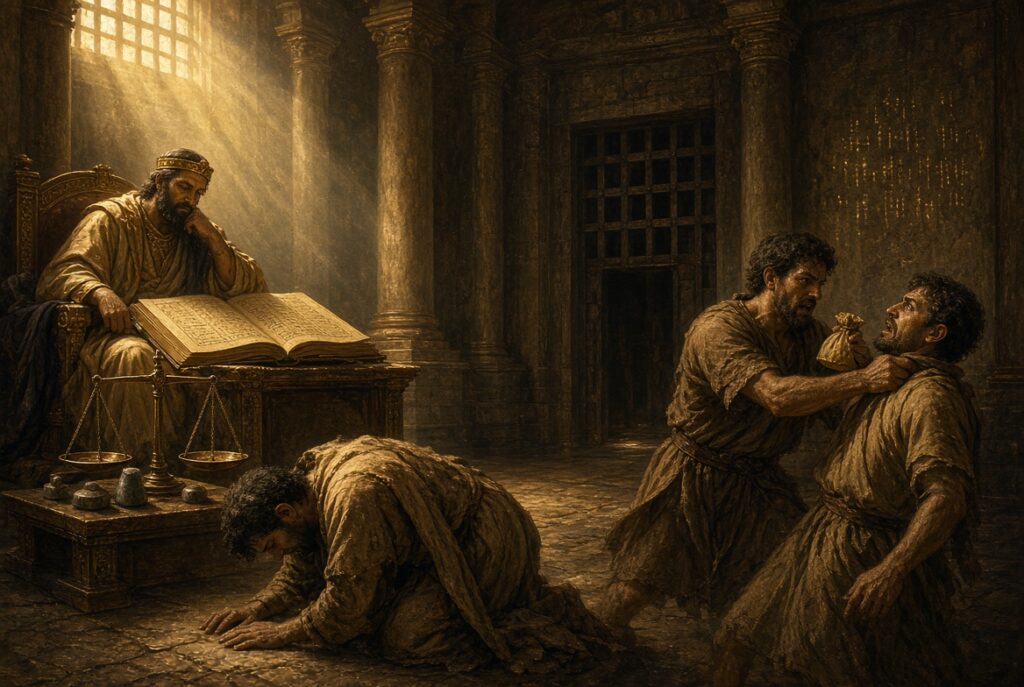
Therefore the kingdom of heaven may be compared to a king who wished to settle accounts with his servants. When he began to settle, one was brought to him who owed him ten thousand talents. And since he could not pay, his master ordered him to be sold, with his wife and children and all that he had, and payment to be made. So the servant fell on his knees, imploring him, ‘Have patience with me, and I will pay you everything.’ And out of pity for him, the master of that servant released him and forgave him the debt.
But when that same servant went out, he found one of his fellow servants who owed him a hundred denarii, and seizing him, he began to choke him, saying, ‘Pay what you owe.’ So his fellow servant fell down and pleaded with him, ‘Have patience with me, and I will pay you.’ He refused and went and put him in prison until he should pay the debt.
When his fellow servants saw what had taken place, they were greatly distressed, and they went and reported to their master all that had taken place. Then his master summoned him and said to him, ‘You wicked servant! I forgave you all that debt because you pleaded with me. And should not you have had mercy on your fellow servant, as I had mercy on you?’ And in anger his master delivered him to the jailers, until he should pay all his debt.So also my heavenly Father will do to every one of you, if you do not forgive your brother from your heart.”
(Matthew 18:21–35)
“I do not say to you seven times, but seventy times seven” (Matthew 18:22). Some English Bibles print “seventy-seven times.” That is not two different Jesuses. It is one Greek phrase—hebdomēkontakis hepta—that can be read either as 70 × 7 or as 77. Both readings are trying to say the same thing: stop counting.
In Genesis 4:24 Lamech boasts, “If Cain’s revenge is sevenfold, then Lamech’s is seventy-sevenfold.” Cain got seven. Lamech inflated the vendetta and sang it. Jesus takes the same rungs on the ladder—7, then 77 / 70×7—and turns the song around. Lamech stacked numbers to justify blood. Jesus stacks them to forbid a limit on pardon. Completeness times completeness. Not a spreadsheet cell. A refusal to let Cain’s math run the household of G-d.
You do not need Greek to hear it. You need Genesis open next to Matthew. Peter offered a complete number. Jesus answered with Lamech’s number—minus the swagger.
A Brief, Unfoaming Word About Four, Seven, Ten, and Ten Thousand Hebrew loves numbers the way a craftsman loves cubits: they measure something real. Four is the earth’s corners, the directions a man can walk without leaving the dirt. Seven is the week G-d finished and blessed. Ten is the fingers that received the words, the tithe that admits the field is not yours, the congregation that makes a minyan. Ten thousand—myriad, rivo, the talent piled until the abacus weeps—is Scripture’s way of saying “more than you can inventory.” Revelation will later speak of myriads of myriads; the point is not a PIN code.
Use them inside the page. Do not use them as a parlor trick. If you flip the Bible in the kitchen, land on a verse whose chapter number matches the microwave clock, and call it a word from the L-rd, you have not discovered typology. You have invented a slot machine and baptized it. Chapter and verse numbers are medieval furniture. The symbolism that belongs to the text is the symbolism the text itself carries—creation’s seven, Lamech’s seventy-seven, the ten thousand talents that no day laborer could ever repay. Keep the numbers between the covers. Leave the microwave alone.
The Parable Is Not a Lesson in Naïve Kingship “Therefore the kingdom of heaven may be compared to a king who wished to settle accounts with his servants” (Matthew 18:23). Ten thousand talents. A talent is already a fortune; ten thousand is comic hyperbole with a straight face. Jesus uses exaggeration the way a prophet uses fire: not to excuse the Psalm that says the wicked borrow and do not pay back (Psalm 37:21), but to make the first debt unpayable on purpose. The man is not a little behind on rent. He is cosmically insolvent.
Why was he in debt to begin with? The text does not give you a tragic backstory. It gives you a steward who handled the king’s goods and came up empty. Mercy is not an audit of how he got there. Mercy is the king’s gut moving—(splagchnizomai σπλαγχνίζομαι)—when the man hits the floor and promises a repayment plan that is itself a joke. The king releases him and forgives the loan. That is not naïveté. That is sovereignty that can afford to cancel what no court could collect.
Then the forgiven man finds a fellow servant who owes him a hundred denarii—real money, lunch-money next to ten thousand talents—and he chokes him. “Pay what you owe.” The same throat that just tasted pardon becomes a loan shark’s tool. What meant more to him? The ledger he could still squeeze, not the treasure in heaven he had just been handed. He stored the king’s mercy like working capital and went back to the only business he understood: other people’s necks.
Is mercy forgiving without chastisement? Not in this story. The king calls him wicked—(πονηρός ponēros)—and hands him to the jailers until he should pay all. Jesus does not whisper the moral. “So also my heavenly Father will do to every one of you, if you do not forgive your brother from your heart” (Matthew 18:35). The Father punishes the wicked. Write that on the wall before you turn the parable into a therapy session.
Discernment: Forgiveness Is Not Amnesia About Wickedness Psalm 37 is not optional wallpaper. The wicked borrow and do not pay. They plot against the righteous. They draw the sword and bend the bow. The psalm does not say, “Pretend the sword is a hug.” It says do not fret, do not envy, trust, do good, dwell, and watch the L-rd cut the arms of the wicked. Treating wickedness as wickedness is not a failure of mercy. It is the only soil in which mercy is not a lie.
The slave’s first debt is the picture of what we owe the Holy One: more than the books can hold. Regeneration is not a sticker that says “account closed, resume shaking throats.” Ezekiel already named the engine: “I will put my Spirit within you, and cause you to walk in my statutes and be careful to obey my rules” (Ezekiel 36:27). The Spirit does not cancel the statutes so the loan shark can keep his profession. The Spirit causes a walk. Forgiveness without that walk is the fig tree with leaves. We have taken a flamethrower to that tree before. The temperature has not dropped.
Universal application is not “everyone gets a participation trophy.” It is: the same King settles every account; the same heart-forgiveness is required of every subject; the same refusal to treat evil as a personality type is required of every saint who still owns a throat. You may forgive seventy times seven and still call a thief a thief. You may refuse to keep a private vengeance calendar and still refuse to finance the next theft. Joseph forgave brothers and still ran Egypt with a grain policy. David spared Saul and still told the truth about the spear.
What Peter Was Told, and What the Parable Will Not Let You Shrink From one angle—the earthly, the temporal—Peter hears a number large enough to outlast a life. Keep forgiving until the man is made whole, or until you are, or until the age ends. That is not a license to be a doormat with a halo. The previous paragraph in Matthew already gave the church a process when a brother will not hear. Forgiveness from the heart and discipline in the assembly are not enemies. They are two hands of the same King.
From the other angle—the parable’s own claim—this is not a seminar on palace management. It is the kingdom of heaven. The first debt is the unpayable one. The second is the one we keep collecting after we have been cut loose. The jailers at the end are not a metaphor you get to sand down until they feel like “natural consequences.” Jesus said the Father will do likewise. Hyperbole in the size of the talent does not cancel the verdict in verse 35. If your hermeneutic needs the Father to be softer than the Son’s last sentence, your hermeneutic is the problem.
Do not undermine the center to look brave. The center is this: you have been forgiven a myriad. Do not put your hands on your brother’s neck over lunch money. Forgive from the heart. Walk in the statutes the Spirit was given to cause. Call wickedness wickedness. Store treasure where rust and loan sharks cannot reach. And when the kitchen clock and a random verse number wink at you, laugh, put the Bible back on the table, and read the parable again.