Between Two Pillars: Samson’s First Kryptonite, the Wife as Type of the World, and What Gets Put Before G-d
The hair was the visible crown of the vow. The strength was never in the locks. The razor was only the last symptom.
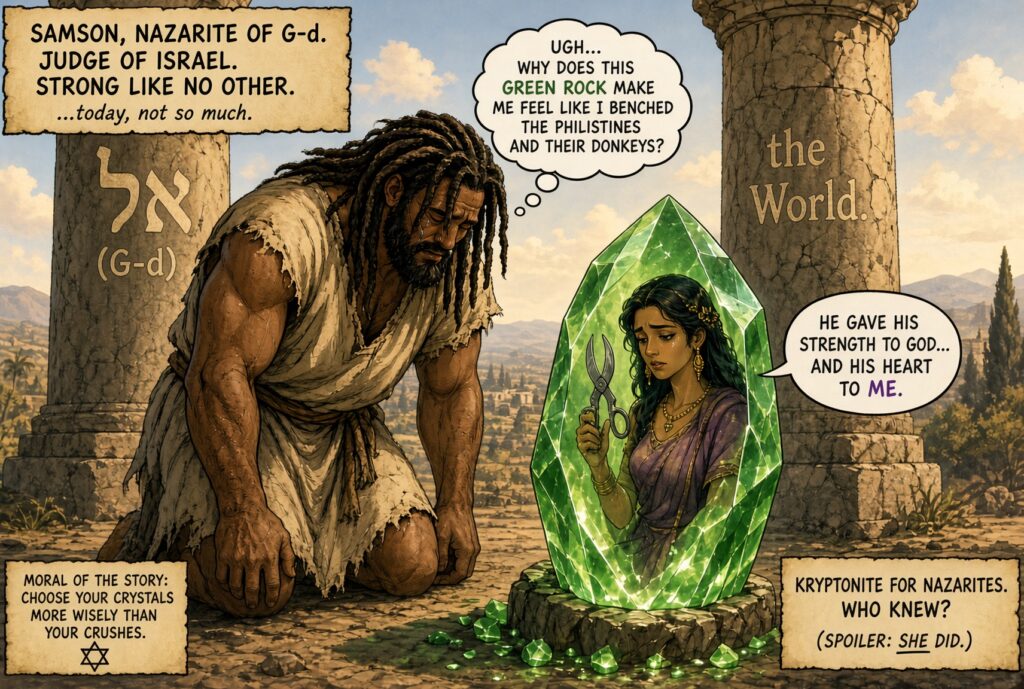
Samson is not the cartoon strongman of Sunday-school flannelgraphs. He is a Nazarite from the womb (Judges 13:5, 7), consecrated before he could choose the vow himself—the same pattern of separation already treated in the Peh stanza of Psalm 119, where the shining face of Numbers 6 is begged by a mouth that pants for commandments. Wine, razor, corpse: the three fences. Samson treated the fences like a thrill-seeker’s obstacle course.
He loved G-d. He also loved riddles, Philistine women, and the electric edge of danger. That combination is the first kryptonite.
Strength That Was Never His Own The Spirit of the L-rd rushed upon him (Judges 14:6, 19; 15:14). The jawbone of a donkey, the gates of Gaza carried uphill like a souvenir, the three hundred foxes with torches—none of it was gymnasium theology. It was ruach, the same breath that hovered over the deep and drove the east wind through the sea. Typology does not erase the history; it reads the history as preparatory. Samson is not Christ. He is the consecrated man who keeps putting something else in the place reserved for the Consecrator.
His true strength was the vow kept. His true weakness was the vow treated as a costume he could take off when the party started.
Riddle Is Not Wisdom True wisdom is G-d. “The fear of the L-rd is the beginning of knowledge” (Proverbs 1:7). Proverbs uses riddles; it does not define wisdom as riddling. A ḥîdâh (חִידָה) is a tool. Worldly wisdom is cleverness that advances the self. True wisdom (chokmah חָכְמָה) is skill in living under G-d’s rule.
There is a holy use of the form. Nathan told David the parable of the poor man’s lamb until the king condemned himself: “You are the man” (2 Samuel 12). The wise woman of Tekoa, sent by Joab, used a story to bend a king’s ear toward mercy (2 Samuel 14). Deborah judged and sang. Huldah spoke the Book into Josiah’s bones. These were not wedding wagers. The riddle, the mashal (מָשָׁל), the pointed tale—when the prophet wields them—make a king kneel and expose folly. Samson’s riddle at Timnah did the opposite. It was a bet for thirty garments. The men squeezed his wife; she wept; he folded. The riddle-user was used. That is worldly wisdom wearing a Nazarite’s hair.
Living on the Edge He walks into Timnah, sees a Philistine woman, and tells his father, “Get her for me, for she is right in my eyes” (Judges 14:3). The same eyes that should have been Ayin—unblinking discernment—become the organ of appetite (his personal object of affection). The pattern is already there: the same transactional spirit that later sits in Delilah’s lap.
Scripture gives Samson one wife: the Timnite (Judges 14). After that, a woman in Gaza who was not a wife (Judges 16:1), and Delilah in the Valley of Sorek, whom he loved—the text never calls her his wife (Judges 16:4). One covenant, then the world’s substitutes. The number is not a harem; it is a pattern. He kept filling the space the vow was meant to occupy.
The allusion is later and sharper. At Jacob’s well a Samaritan woman meets the greater Bridegroom. “You have had five husbands, and the one you now have is not your husband” (John 4:18). Five marriages, a sixth arrangement that does not even rise to the name. She was filling a void with men the way Samson filled it with Philistine eyes, riddles, and the edge. The sin was not that she had a past G-d could not touch. The sin was thirst treated as a creature’s job: husband after husband, well after well, and still no living water. Worship on the mountain or in Jerusalem while the heart stays dry. Samson’s Timnite, the Gaza night, and Delilah rhyme with those five-plus-one. The void is not cured by another body “right in my eyes.” It is cured when the One who is true wisdom stands at the well and says, “Give me a drink”—and then becomes the spring.
The Wife as Type of the World Delilah is not a cartoon villainess, and she is not an excuse to baptize contempt for women. She is a type. In the same way the older serves the younger without dissolving the patriarchs into allegory, Delilah functions as a historical correspondence G-d Himself laid down: the world in a covenant-shaped room.
What Samson put before G-d—desire, amusement, the next conquest, the riddle that would make him look clever—she puts before her husband under G-d: silver, safety, the lords of the Philistines. She is the reflection, not the independent source. The kryptonite is not merely the woman; it is the consecrated man who handed her the shears by living as if the vow were optional. The world does not invent a new strategy. It only sits where the Nazarite already placed his heart.
That is why the story sits so early in the line. The world will always ask the consecrated man to explain the secret of his strength in language the market can spend. A wife who has made the world her first loyalty will press the same question Samson’s first wife pressed at Timnah and Delilah pressed at the loom: tell me, that I may tell them. The pressure is not always eleven hundred pieces of silver. Sometimes it is respectability, quiet, the children’s comfort, the fear of being the difficult one, the hunger to be “right in the eyes” of the age.
When a Man and a Woman in Holy Covenant Are at Ends Holy covenant is not a truce between two sovereignties. It is two people under one G-d. When they are at ends, one has begun to treat the other as a means, or G-d as a mascot for the household brand. The world enters the marriage the same way it entered Samson’s: not first with a razor, but with a request that sounds like intimacy—“Tell me where your strength lies.”
A husband who lives on the edge—riddles, appetites, the thrill of being needed—trains his wife to negotiate with the Philistines because he has already taught her that the vow is flexible. A wife who loves the approval of the lords more than the fear of the L-rd will use tears, silence, or leverage the way Delilah used the loom. Neither is licensed to play the victim of typology. The world is not “her.” The world is whatever either spouse puts in the place of G-d and then demands the other bow to.
A reminder, already written into Israel’s later constitution for kings: do not multiply horses, do not multiply silver and gold, and do not multiply wives, lest the heart turn away (Deuteronomy 17:16–17). Extra wives were never romance. They were peace treaties with the nations—Philistine policy in the bedchamber. Samson did not need a harem to commit the same error. One woman “right in his eyes” was enough to import the world into the vow. The warning still stands: covenant is not a stack of alliances. It is one man, one woman, under one G-d. Multiply the world’s guarantees and the heart turns. The pillars do not care how diplomatic the marriage looked.
Abraham wanted a son. The wanting was not the sin. Making the promised thing unsacrificeable was the danger. G-d tested him so that nothing—not even covenant fruit—would sit above the Giver. It is never too late to repent, no matter how deep in the neck a household is. G-d sees past the temporal situation.
Was it for the glory of G-d alone? That is the only question that can pull a marriage back from the pillars. Not “who started it.” Glory. If the answer is no, the house is already leaning.
Between Two Pillars At the end he stands between two pillars, hair grown again, eyes gouged out, a spectacle for Dagon. He prays one last time—not for a restored marriage, not even for escape, but that he might be avenged for his two eyes (Judges 16:28). The house comes down. Everybody is taken out. It is a dreadful ending and a terrible mercy.
The two pillars are not architecture. They are the early line Scripture draws between G-d and the world. Moses stood between walls of water. Jonah sat in the belly of the dragon of the deep. Isaiah received coal on unclean lips. Nathan made a king kneel with a story. Samson stands between the pillars and pulls—having used the riddle to advance himself rather than to expose his own folly before G-d.
The Nazarite bar was never lowered for him. It was raised from the womb: no wine, no razor, no corpse (Numbers 6; Judges 13:5, 7). He wore the identity and then treated the standard as optional. One wife at Timnah; a night in Gaza that was not a wife; Delilah, whom he loved and whom the text never calls wife (Judges 16:4). The vow assumed, the life beneath it. That is not “the bar came down.” That is a man standing under a raised bar and calling the gap freedom.
Read the collapse slowly. A consecrated man yoked to what is not G-d; the world sitting in the room where a wife would have belonged; the house of Dagon coming down on both. It is history first. It may also be an early hint of a later decree. G-d will one day speak of a certificate of divorce He wrote against faithless Israel—“I had sent her away with a decree of divorce” (Jeremiah 3:8; cf. Isaiah 50:1). Samson’s last stand does not become that oracle. It rhymes with it: when the vow is treated as a costume and the world is taken into the house, the pillars do not negotiate. They fall.
The type is not “Samson = Jesus” and it is not “Delilah = every wife.” The type is the consecrated man who must learn that the strength was never in the hair, the riddle, or the one who was right in his eyes.
Augustine (of Hippo) is not Samson, and he took no Nazarite vow. He is a later witness that the bar does not drop because a man was deep in the neck. He lived years with a concubine, fathered Adeodatus, dismissed her for a better match, took another woman while he waited—and then G-d made a theologian out of the wreck (“illicit loves” in Carthage Book 3 ‘engaged in fornication and concubinage’). Grace did not canonize the concubinage. It taught him to call lust by its name and to preach a holiness he had not kept. The Nazarite standard is not repealed by later saints. It is exposed: the vow was always G-d’s (Matthew 5:33-37), and repentance is still possible after the shears.
The world will sit where a covenant spouse should sit and ask for the secret. The man who answers without first answering G-d will wake up shorn. It is never too late. The vow can be kept again. The face can shine again. Even after a decree, the prophets still cry, “Return.” The pillars can still fall on the right house—if the first loyalty is no longer the world wearing a wedding garment.