Uncommanded Coal: Nadab and Abihu, the Two Principles, and the Flame the Guild Could Not Keep
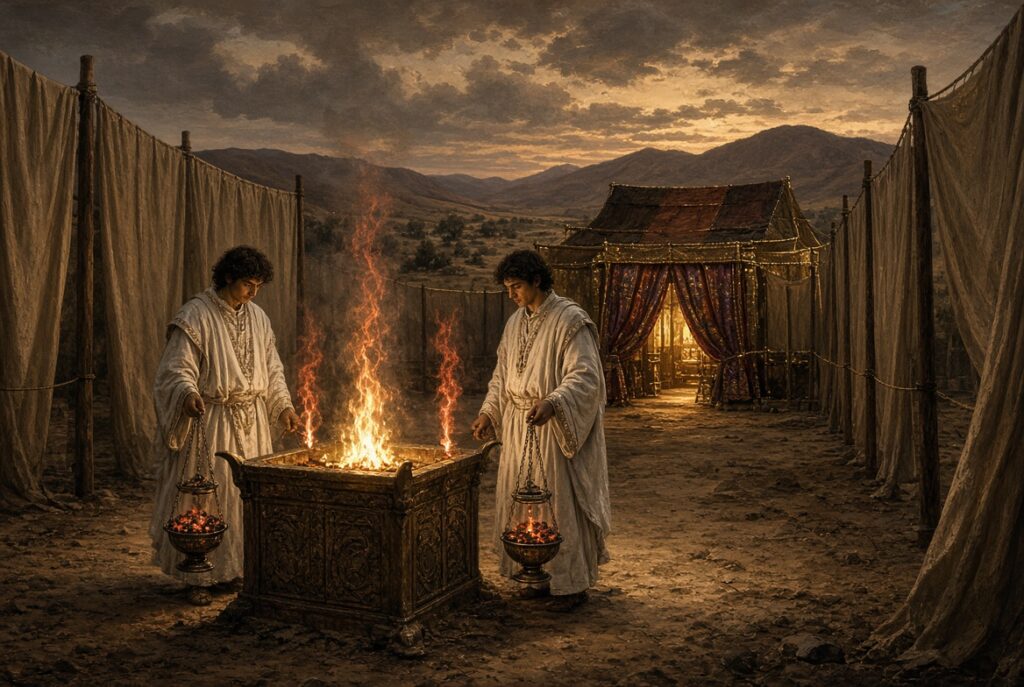
They took their censers and offered strange fire, which He had not commanded them. The altar’s fire was already lit.
Leviticus 10:1–3 Now Nadab and Abihu, the sons of Aaron, each took his censer and put fire in it and laid incense on it and offered aunauthorized fire before the Lord, which he had not commanded them. And fire came out from before the Lord and consumed them, and they died before the Lord. Then Moses said to Aaron, “This is what the Lord has said: ‘Among those who are near me I will be sanctified, and before all the people I will be glorified.’ ”And Aaron held his peace.
The last piece left a son of the prophets on the road with a wound he had to get. First ask: the Name, and please. Second ask: please, no Name, to a man the text will not enroll in the guild. The sign still rose. The bother remained. This piece is the same bother in another court.
Nadab and Abihu take their censers, put fire in them, lay incense on it, and offer strange fire before the L-RD, which He had not commanded them (Lev 10:1). Fire comes out from the presence of the L-RD and consumes them (10:2). Moses speaks what Aaron cannot answer: Among those who are near me I will be sanctified, and before all the people I will be glorified (10:3). Aaron holds his peace.
The verse does not say the incense was cheap. It does not say the brothers were bored. It says the fire was not commanded. That is the whole case.
Two principles still divide the house.
The regulative principle: in the worship of G-d, what He has not commanded is forbidden. The Word sets the table. Hands do not improve the menu.
The normative principle: what He has not forbidden may be added, if it seems helpful, decent, or alive. The Word sets a fence. Hands plant inside it.
One treats silence as a wall. The other treats silence as a field.
Nadab and Abihu had a field. They had proximity—sons of Aaron, first week of the consecrated house, fire already on the altar that had been commanded, fire that came out from before the L-RD and consumed the burnt offering (Lev 9:24). The bush had spoken and not consumed the wood (Ex 3:2–4). This court had already heard the same Voice in flame. They did not wait for that fire. They brought their own. Enthusiasm is cheap. Lions know the difference. So does the fire that answers from the sanctuary (Lev 10:2).
The effects are not theoretical. Communions that began by treating the silence of Scripture as permission have a public record. Offices the apostles did not open. Voices the assembly was not told to set over itself. Women elders are only the visible marker; the method is older. Once “He did not say we may not” is a sufficient warrant, the warrant never stops. The slope is not a taunt. It is a history. Strange fire does not stay in the censer. Some play with it and discover they do not hold the flame. The flame holds them.
This is not a brief against joy, or against order, or against the ordinary means used as they were given. It is a brief against the extra coal—the gesture that looks like ministry because it burns. The son on the road had a word for the first ask. The second ask had manners. The watchman, asked twice what of the night, did not light a private lamp. Morning comes, and also the night. If you will inquire, inquire; return (Isa 21:12). Nadab and Abihu had censers. Ahab had a treaty and a garden. The pattern is the same: when the Word will not sit where it was placed, men stage what they think the moment requires. Worldly method. Wrong altar.
Nicodemus knew that hour. He came by night (John 3:2). Inquire. Return. Two do not walk together unless they are agreed (Amos 3:3). A man who has walked with a pastor through thick and thin still sometimes approaches like that—not as a spy with a grid, but as one who cannot tell whether the question will be received as loyalty or as test. Even yoke, night hour. The world’s sixteen types would like a turn at the same door. Bring the chart to Jesus and see what survives. He does not flatter a temperament. He takes each one to the ideal and leaves no room for the alibi. The type cannot arrive there. That is not cruelty. That is definition.
The same math as the confession: only add, never subtract. The Son does not empty the G-dhead to make room for flesh. G-d was not lacking. He assumed humanness without remainder of deity, and without remainder of the human He came to wear (John 1:14; Phil 2:6–8; Heb 2:14–17). Ideal man. Unsubtracted G-d. The call on the near ones is the same shape: holiness in worship, nothing taken from His character to make the service easier, nothing laid on the altar that He did not light. Extra coal is the opposite formula. It subtracts the command and adds the spark.
Ideal law is quieter. If the king writes the scroll and keeps his heart from lifting up (Deut 17:18–20), the servant does not invent a liturgy to wake him. The other king writes nothing and says in his heart, I will ascend (Isa 14:13–14). That is the spark that does not wait for the altar. If the priest takes fire from the altar G-d lit, he does not need a private coal. If the church lets the apostolic pattern stand, she does not need to keep adding furniture and calling it life.
Aaron’s sons died at the doorway. The guild’s extra blow only wounded a prophet and convicted a king who went home sullen. Different temperatures. Same unauthorized heat. The L-RD still will be sanctified in those who come near. The question for every denomination that began with a larger field is whether the field is still His—or whether the coal has been in their hand so long they can no longer tell commanded fire from the kind that merely burns.