From “Dead Dog” to King’s Table: Mephibosheth, the Lame Heir Who Lived Psalm 23
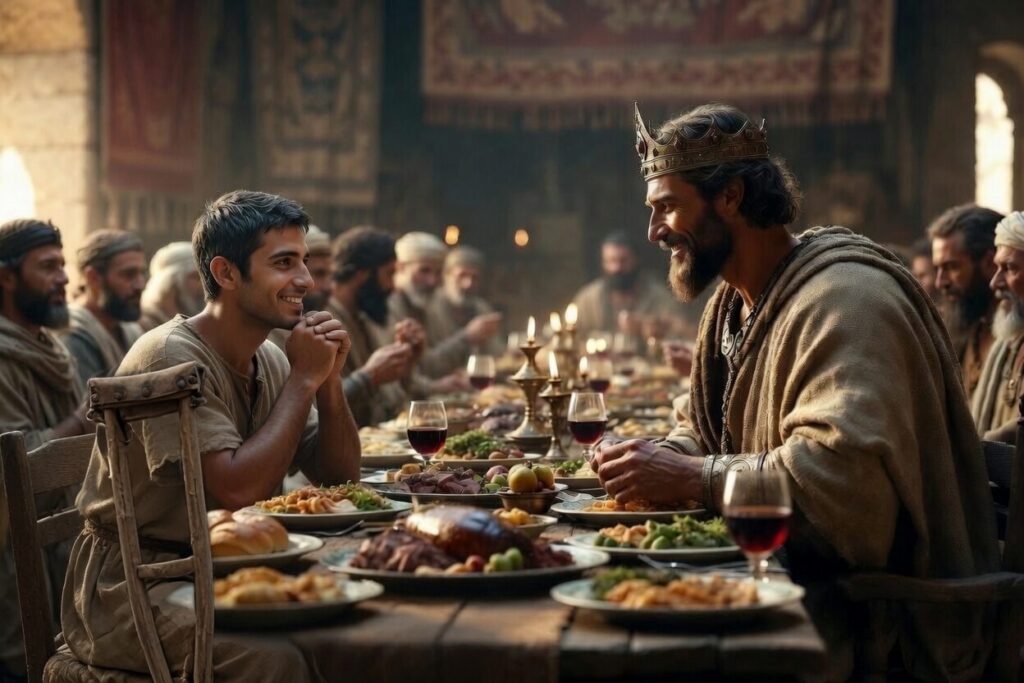
“Let him take it all, as long as my lord the king has come home safe in peace.” (2 Samuel 19:30 ESV) Young Mephibosheth — lame in both feet since the fall in Lo-debar — sat contentedly beside the king. With crutch nearby yet unneeded at the table of grace, he sought nothing more than the presence of his lord. The Shepherd had prepared this place, and the lame heir found rest in the house of David.
Saul and David: The Anointed and the Pursued In the unfolding drama of the monarchy in Israel, the relationship between Saul and David stands as a profound study in divine sovereignty, human frailty, and the cost of covenantal fidelity. Saul, the first king, chosen and anointed by the L-rd through Samuel (1 Samuel 10), began with promise but descended into paranoia and rebellion against G-d’s word. David, the shepherd boy anointed in the midst of his brothers while Saul still reigned (1 Samuel 16:1-13), entered Saul’s service as musician and warrior, his victories a constant reminder of the transfer of the kingdom.
The narrative in 1 Samuel traces a trajectory from initial favor to murderous jealousy. David’s triumph over Goliath and subsequent successes ignited Saul’s fear: “Saul was afraid of David because the Lord was with him but had departed from Saul” (1 Samuel 18:12 ESV). Saul’s attempts to destroy David—through direct spear thrusts, plots involving his daughters, and relentless pursuit into the wilderness—reveal a king unmoored from trust in Hashem. Yet David repeatedly honored Saul as “the L-rd’s anointed,” refusing to lift his hand against him even when opportunity arose in the cave at Engedi (1 Samuel 24:6, 10 ESV) and again in the camp (1 Samuel 26).
David’s restraint exegetes a theology of waiting on divine timing: the kingdom belongs to the L-rd, not to grasping ambition. Saul’s final acknowledgment, “You are more righteous than I” (1 Samuel 24:17 ESV), and his plea for mercy on his offspring underscore the tragic irony. The house of Saul would fall on Mount Gilboa, with Saul and his sons slain (1 Samuel 31), yet David mourned them deeply (2 Samuel 1), composing a lament that honored even his enemy.
Jonathan and David: A Covenant of Brotherly Love Threaded through this conflict shines the luminous friendship between Jonathan, Saul’s son and heir apparent, and David. “As soon as he had finished speaking to Saul, the soul of Jonathan was knit to the soul of David, and Jonathan loved him as his own soul” (1 Samuel 18:1 ESV). This was no mere affection; it was covenantal, marked by Jonathan’s gift of robe, armor, and weapons (1 Samuel 18:4) and solemn oaths before the L-rd (1 Samuel 20:8, 16-17, 42 ESV).
Jonathan’s loyalty to David, even against his father’s rage, exemplifies self-emptying love. He warned David of Saul’s plots, strengthened his hand in G-d (1 Samuel 23:16-18 ESV), and affirmed David’s future kingship while accepting a subordinate role: “You shall be king over Israel, and I shall be next to you” (1 Samuel 23:17 ESV). Their bond, tested in secrecy and farewell, survived Jonathan’s death and became the ground for David’s later kindness. Exegetically, it models hesed (חֶסֶד)—covenant loyalty—that transcends blood and ambition, a rare light amid the shadows of Saul’s court.
Psalm 23 The Lord is my shepherd; I shall not want. He makes me lie down in green pastures. He leads me beside still waters. He restores my soul. He leads me in paths of righteousness for his name’s sake. Even though I walk through the valley of the shadow of death, I will fear no evil, for you are with me; your rod and your staff, they comfort me. You prepare a table before me in the presence of my enemies; you anoint my head with oil; my cup overflows. Surely goodness and mercy shall follow me all the days of my life, and I shall dwell in the house of the Lord forever.
Mephibosheth: The Lame Heir of a Fallen House The shadow of death hung heavily over Saul’s line. Jonathan’s son Mephibosheth (meaning “shameful thing” or “exterminating the idol,” a name echoing the era’s violence) was five years old when news of the defeat at Jezreel reached his nurse. In her haste to flee, she dropped him, and “he became lame in both his feet” (2 Samuel 4:4 ESV). The house of Saul suffered further decimation: executions, betrayals, and even negotiated deaths. To end a famine, David delivered seven of Saul’s descendants to the Gibeonites for execution as atonement for Saul’s earlier breach of treaty (2 Samuel 21:1-9 ESV)—a grim reminder that the sins of the father visited the generations, often through political expediency and “peace treaties” sealed in blood.
Yet amid this slaughter, one lame grandson survived in obscurity at Lo-debar (“no pasture”), a place of desolation. When David inquired, “Is there still anyone left of the house of Saul, that I may show him kindness for Jonathan’s sake?” (2 Samuel 9:1 ESV), Ziba identified Mephibosheth. Summoned to the king, the cripple fell on his face in terror, calling himself “a dead dog” (2 Samuel 9:8 ESV). David’s response was restorative grace: “Do not fear, for I will show you kindness for the sake of your father Jonathan, and I will restore to you all the land of Saul your father, and you shall eat at my table always” (2 Samuel 9:7 ESV).
David’s upset at Mephibosheth’s absence during key moments, such as aspects of the anointing or return (echoed in the narrative’s emphasis on his lameness preventing full participation), underscores the physical barrier that marked his life. Yet David elevated him: Ziba and his household were to farm the lands for Mephibosheth, who would dine continually “like one of the king’s sons” (2 Samuel 9:11 ESV). Mephibosheth lived in Jerusalem, at the king’s table, lame yet honored (2 Samuel 9:13 ESV).
Later, during Absalom’s rebellion, Ziba slandered Mephibosheth, claiming disloyalty to seize the possessions (2 Samuel 16:1-4 ESV). David, in haste, granted them to Ziba. Upon return, Mephibosheth appeared unkempt in mourning, protesting Ziba’s deception and declaring, “Let him take it all, as long as my lord the king has come home safe” (2 Samuel 19:30 ESV; see vv. 24-30). He sought neither full restoration nor increase, content in loyalty to his lord and king.
Mephibosheth and the Shepherd’s Psalm Mephibosheth’s life exegetes the experiential reality of Psalm 23 with poignant clarity. He “walked through the valley of the shadow of “death”—literally and figuratively—from the battlefield trauma that crippled him as a child, through the fear of annihilation that shadowed Saul’s remnants, the isolation of Lo-debar, and the political betrayals that threatened even the king’s table. Enemies surrounded; death stalked the house of Saul. Yet the L-rd, through David His servant, prepared a table “in the presence of my enemies” (Psalm 23:5 ESV). Anointed with the oil of favor, his cup overflowed with unmerited provision. Goodness and mercy pursued him, not as abstract theology but as the steadfast hesed of a king who remembered covenant. He dwelt in the house of the king all his days.
David treated Mephibosheth with extraordinary kindness—restoring lands, providing servants, and granting perpetual access to the royal table—despite the enmity inherent in Saul’s line. This raises the possibility that David, the man after G-d’s own heart, loved his enemy as he hoped to be loved by the grace of the L-rd. Having himself been pursued and spared by divine mercy, David extended covenantal hesed to the vulnerable remnant of the fallen house. In a world of negotiated deaths and generational curses, Mephibosheth sat at the table—not as a threat, but as a son.
This account, rich in historical exegesis, may also function as typology or even the lived inspiration by which David penned Psalm 23. The shepherd-king who provided for the lame heir mirrors the divine Shepherd. Deliberately, this reflection avoids Christological overlay, lingering instead on the Old Testament textures of promise, frailty, loyalty, and table-fellowship under sovereign grace—so that we might more fully empathize with king David on his own terms, entering his lived experience of covenantal hesed, fear, mercy, and kingship without rushing forward to later fulfillment. In Mephibosheth we glimpse how the valley leads not to oblivion, but to the sustaining presence of the King.