Psalm 119:105–112 The Problem of Good for Evil: How a Lamp Exposes the Darkness
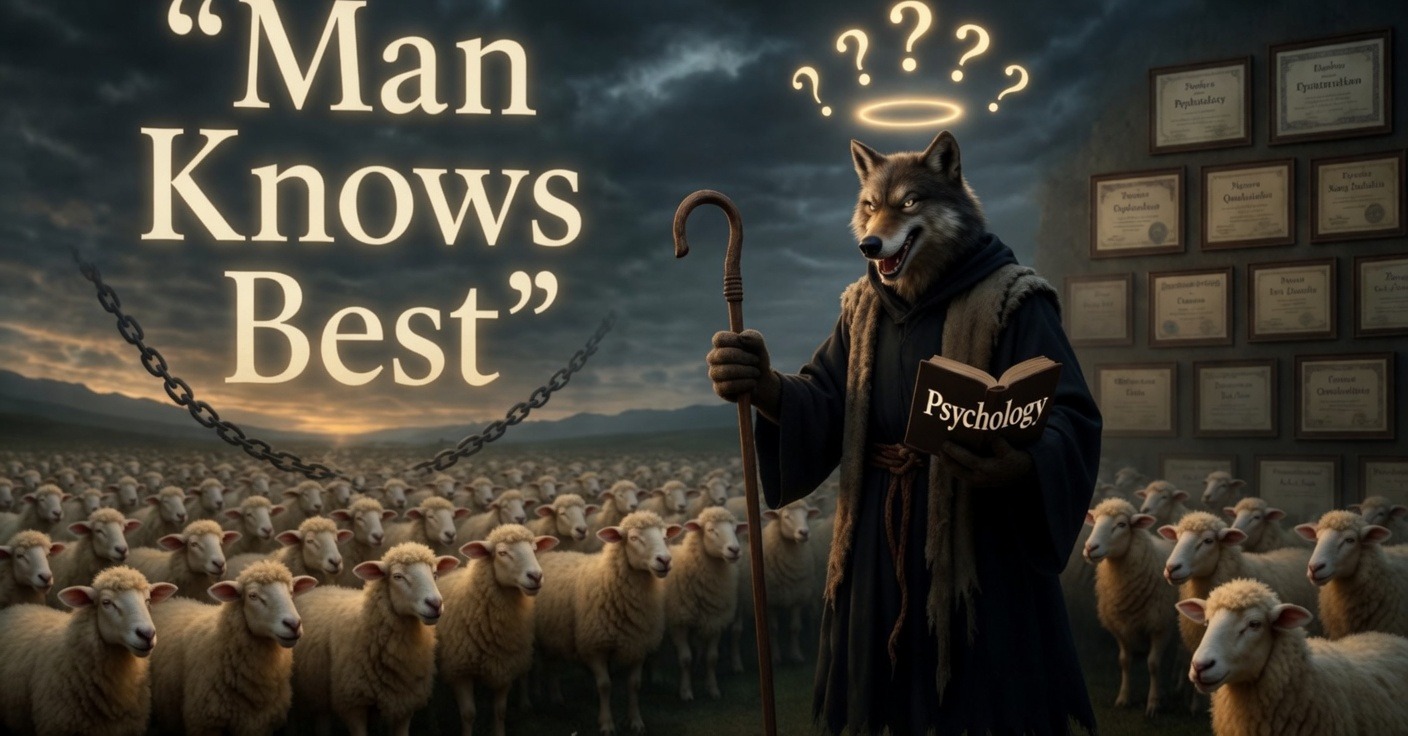
The governing lights of Genesis 1 ordering creation while the forces represented by the wolf remain subject to them—yet still capable of operating in the shadows where men turn from the Lamp.
Continuing our journey through the majestic acrostic of Psalm 119—where the psalmist’s love for Torah makes him “smarter than [his] enemies… teachers… and elders”—we arrive at the Nun stanza (verses 105–112). Here the psalmist declares with luminous clarity:
Psalm 119:105–112
Your word is a lamp to my feet and a light to my path. I have sworn an oath and confirmed it, to keep your righteous rules. I am severely afflicted; give me life, O L-rd, according to your word! Accept my freewill offerings of praise, O L-rd, and teach me your rules. I hold my life in my hand continually, but I do not forget your law. The wicked have laid a snare for me, but I do not stray from your precepts. Your testimonies are my heritage forever, for they are the joy of my heart. I incline my heart to perform your statutes forever, to the end.
This is no polite piety. It is a defiant, oath-bound stand against primordial darkness.
Stumbling in the Dark Genesis opens with haunting poetry: “The earth was without form and void, and darkness was over the face of the deep” (Genesis 1:2). Formless. Void. Dark. This is the default state of a cosmos without the ordering Logos of Hashem. That Logos—fully unpacked in John’s prologue—is the mind of the G-dhead made manifest: “In the beginning was the Word, and the Word was with God, and the Word was God… In him was life, and the life was the light of men. The light shines in the darkness, and the darkness has not overcome it.” (John 1:1, 4–5)
Light is not merely illumination; it is life itself. In the opening verses of Genesis, we encounter a profound mystery: “And God said, ‘Let there be light,’ and there was light. And God saw that the light was good. And God separated the light from the darkness” (Genesis 1:3–4). This primordial light bursts forth on Day “one”—long before the sun, moon, and stars appear on Day 4. It cannot be reduced to the visible electromagnetic radiation our eyes perceive, nor to the solar spectrum that sustains physical life. Rather, it is the deeper, ordering reality of G-d Himself: the divine Logos bringing form, coherence, fruitfulness, and goodness out of tohu wa-bohu—the formless, void, barren, and chaotic darkness over the face of the deep (Genesis 1:2).
Throughout the creation account, G-d repeatedly affirms this goodness: after forming the seas and dry land (Genesis 1:10), after bringing forth vegetation (Genesis 1:12), after setting the lights in the heavens (Genesis 1:18), and after creating sea creatures, birds, and land animals (Genesis 1:21, 25). The climax comes in Genesis 1:31: “God saw all that he had made, and it was very good.” Creation, bathed in this divine light and order, fully reflected G-d’s own goodness.
Yet Jesus later makes a striking point that underscores the gulf between created goodness and the perfect source of all goodness. When a man addressed Him as “Good Teacher,” Jesus replied, “Why do you call me good? No one is good—except God alone” (Mark 10:18; cf. Luke 18:19). This does not diminish the original “very good” of creation but highlights that true, intrinsic, and perfect goodness belongs to G-d alone. Human and created goodness is derivative—reflecting the light of its Maker—while any claim to independent or ultimate goodness falls short in light of G-d’s holiness. The primordial light thus points us back to the divine Goodness that orders all things and exposes every deviation from it.
Where G-d’s Law is absent or twisted, humanity inevitably reverts to that same primordial chaos and emptiness. Israel’s history repeatedly illustrates this regression: covenant fidelity gives way to idolatry, and the nation gropes like blind men in twilight. The same pattern repeats today in the dark veil of worldliness. Modern sophists—spiritual heirs of the Pharisaic school—burden people with humanistic traditions, whether ancient legalism or today’s ever-shifting “social justice” dogmas and woke agendas that twist Scripture while ignoring authorial intent. One almost admires their consistency: heavy yokes are ever in fashion. Yet the sheer existence of G-d is an axiom that evil finds deeply inconvenient. Good is not a neutral background; it is positive reality. Evil is the parasite, the privation. The lamp of G-d’s word exposes the fraud. No wonder the darkness rages—it has been outed. Those who refuse this light possess eyes yet cannot see (Isaiah 6:9; Matthew 13:13–15), trapped in a self-imposed eclipse even as the divine order shines.
Walking in Light All people, Jew or Gentile, share a common diagnosis: total depravity. We do not merely stumble; we are spiritually dead in trespasses (Ephesians 2). Recall Nicodemus, that esteemed “teacher of Israel” who came to Jesus by night (fittingly). He could not grasp the necessity of regeneration—being born again of water and Spirit so that the indwelling Spirit makes the dead alive (John 3; Ephesians 2:1–5). External law-keeping or moral posturing avails nothing without this divine quickening. The psalmist, however, walks in light because he clings to the lamp. He has sworn an oath (v. 106) and, though “severely afflicted” (v. 107), cries out for life according to G-d’s word while offering “freewill offerings of praise” (v. 108). Even while holding his “life in [his] hand continually” (v. 109) and evading the snares of the wicked (v. 110), he refuses to forget the law or stray from the precepts. G-d’s testimonies become his “heritage forever” and “the joy of [his] heart” (v. 111), leading him to incline his heart toward obedience “forever, to the end” (v. 112). His conscience convicts—not as a tormenting fire that burns without giving light, but as a guide that turns the soul toward G-d. Jesus warned, “For what will it profit a man if he gains the whole world and forfeits his soul?” (Matthew 16:26). A seared or tormented conscience may rage like unlit flames, blinding eyes and minds. As both Isaiah and the Messiah declared of hardened hearts, “You will indeed hear but never understand, and you will indeed see but never perceive.” (Isaiah 6:9; cf. Matthew 13:13–15) The mind that refuses the light possesses eyes yet cannot see, ears yet cannot hear. It is a self-imposed eclipse.
The Ancient Apologist: Job as Paradigm No figure better embodies walking by this lamp amid darkness than Job—the oldest book in the biblical canon. G-d Himself declares him “blameless and upright, one who feared God and turned away from evil” (Job 1:1, 8). Repeatedly we read that Job did not sin with his lips (Job 1:22; 2:10). He prayed for his friends, defended G-d’s justice even while lamenting, and acted as the primordial apologist. Long before Peter penned the charge, Job lived it: “always being prepared to make a defense to anyone who asks you for a reason of the hope that is in you” (1 Peter 3:15).
Some modern Christological enthusiasts are quick to undercut practical righteousness, throwing theological haymakers that aim to knock out any emphasis on holy living. Yet the apologist’s fight is not won by such cheap shots. Fair enough—soteriology has always been by grace alone (sola gratia), through faith alone (sola fide). Yet Timothy reminds us that “all Scripture is breathed out by God and profitable for teaching, for reproof, for correction, and for training in righteousness” (2 Timothy 3:16). Job did what was right, and G-d affirmed it. This righteousness was no mere external veneer; it flowed from a living faith that expressed itself in concrete action. James could have had figures like Job in mind when he thundered that “faith without works is dead” (James 2:17, 26). A faith that produces no obedience is no faith at all—it is a corpse, useless for the pilgrim walking through darkness.
The Hebrews “hall of faith” in chapter 11 drives this home with equal force. The chapter does not celebrate a fatalistic or passive trust that sits idly by while chaos reigns. Instead, it parades heroes whose faith was inextricably tied to works: “By faith Noah… prepared an ark”; “By faith Abraham… obeyed when he was called to go out”; “By faith Moses… refused to be called the son of Pharaoh’s daughter” and “left Egypt” (Hebrews 11:7, 8, 24–27). These were not abstract believers but doers who acted on the lamp of G-d’s word even when the path looked impossible. Their faith was dynamic, costly, and visible—precisely the kind that Job modeled amid his trials. In Job 19, the suffering servant of Uz looks beyond his pain: “I know that my Redeemer lives, and at the last he will stand upon the earth” (Job 19:25). This is not novel Christology smuggled backward; it is the consistent faith of the Bible from first page to last. Justification has always been by grace through faith—the five solas in seed form—yet that faith has always been the kind that works, obeys, and holds fast to the lamp when every shadow presses in.
Thus Job stands as a timeless paradigm: the ancient apologist whose blameless conduct, hopeful defense, and redemptive vision expose the bankruptcy of a cheap, works-denying piety. In him we see that the lamp does more than illuminate the next step; it kindles a life of defiant righteousness that the darkness cannot overcome.
The Suffering Servant and Every Servant of G-d This theme finds its crescendo in Isaiah’s Suffering Servant (Isaiah 52–53), yet the language applies—without diminishing its ultimate fulfillment in the Messiah—to every faithful servant. Job suffered. David, the shepherd-king who was no literal shepherd during his reign but a metaphorical one, suffered. The language is richly typological: Jesus was a carpenter by trade, yet the Good Shepherd who tells Peter, “Feed my sheep” (John 21). As Jesus reminds His followers in the Sermon on the Mount, “Rejoice and be glad, for your reward is great in heaven, for so they persecuted the prophets who were before you” (Matthew 5:12).
Suffering can indeed mark faithful servants, but let’s not turn it into some simplistic litmus test—plenty of folks in Christendom rack up suffering thanks to false doctrines, self-inflicted drama, or outright hypocrisy, not because they’re secretly the next Job or Isaiah. Real faithfulness shows up in obedience and fruit, not just in how loud you can groan under the weight.
Metaphor bridges the Testaments. Every servant of G-d endures affliction while holding the lamp, offering praise and refusing to stray. This statement highlights how figurative language unites the Old and New Testaments. It presents faithful servants of G-d as those who cling to His Word—the “lamp”—amid suffering, echoing the psalmist’s resolve in Psalm 119:105–112.
Literal Interpretation and the Function of Metaphor Biblical interpretation begins with the author’s intended meaning in its original context. A metaphor directly equates one thing with another to highlight shared qualities, transferring insight from a familiar realm to a spiritual or abstract one. This approach preserves the literal sense—what the writer meant—while recognizing the figurative vehicle that carries deeper truth.
For instance, when Jesus declares, “I am the door” (John 10:9: “I am the door. If anyone enters by me, he will be saved and will go in and out and find pasture”), the statement is not claiming He is a physical wooden structure. The intended meaning is that He is the exclusive way of access to salvation and security. Interpreting this according to its clear intent avoids distortion and uncovers the rich theological point.
Metaphors create a natural bridge between the Testaments through recurring imagery—light versus darkness, shepherd and flock, vine and branches—that moves from Old Testament foundations and prophecies into New Testament fulfillment in Christ and His people. The “lamp” of Psalm 119:105 (“Your word is a lamp to my feet and a light to my path”) connects directly to Jesus as the Light of the World (John 8:12) and to believers who reflect that light. The pattern of enduring affliction while holding fast appears consistently: in Job, David, the prophets, and the followers of Jesus (Matthew 5:10–12).
Indicators That Signal a Metaphor Several contextual features help identify metaphorical language:
The statement becomes absurd or impossible if pressed in a woodenly physical sense (for example, “Let the dead bury their own dead” in Luke 9:60 refers to spiritual deadness, not literal burial by corpses).
Cultural or historical details in the surrounding text provide the key (as with local water systems, e.g., aqueducts).
The genre—poetry, prophecy, parable, or apocalyptic—often employs such figures.
The comparison isolates specific shared traits (protection, sustenance, usefulness) without claiming total identity. Jesus or the biblical writer sometimes explains the image, or parallel passages clarify it.
Examples of Metaphors Bridging the Testaments and Addressing Specific Audiences
The Lamp/Light Imagery Psalm 119:105: “Your word is a lamp to my feet and a light to my path.” This finds expansion in John 1:4–5: “In him was life, and the life was the light of men. The light shines in the darkness, and the darkness has not overcome it,” and John 8:12: “I am the light of the world. Whoever follows me will not walk in darkness, but will have the light of life.”
Faithful servants endure affliction yet praise and obey (Psalm 119:107, 109–110), refusing snares of the wicked—precisely the experience of New Testament believers who walk by this light amid opposition. The lone wolf evokes adversarial forces (1 Peter 5:8: “Your adversary the devil prowls around like a roaring lion, seeking someone to devour”), set against the guiding path of light.
Hot, Cold, and Lukewarm—Tailored to a Local Audience Revelation 3:15–16: “I know your works: you are neither cold nor hot. Would that you were either cold or hot! So, because you are lukewarm, and neither hot nor cold, I will spit you out of my mouth.”
Jesus draws on the everyday reality of Laodicea’s water supply. The city relied on aqueducts bringing water that arrived lukewarm and sediment-laden—neither refreshingly cold (like streams from Colossae) nor therapeutically hot (like the medicinal springs of Hierapolis). Both extremes were useful; the tepid mixture was nauseating. This metaphor, rooted in the audience’s civic infrastructure, rebukes spiritual complacency and uselessness. It echoes Old Testament critiques of half-hearted covenant loyalty while speaking directly to the Laodicean context, much as metaphors drawn from construction or manual trades would resonate with workers in those fields.
Fishers of Men—Profession-Specific Calling Matthew 4:18–19: “While walking by the Sea of Galilee, he saw two brothers, Simon (who is called Peter) and Andrew his brother, casting a net into the sea, for they were fishermen. And he said to them, ‘Follow me, and I will make you fishers of men.’”
Jesus employs the brothers’ daily occupation—casting nets, patient labor, abundant harvest—to describe gospel mission. This reaches them immediately while extending Old Testament harvest and gathering imagery (Jeremiah 16:16). In the same way, a message to construction workers might draw on building the temple or laying foundations (1 Corinthians 3:9–10; Ephesians 2:19–22).
Additional bridging examples include the shepherd (Psalm 23 to John 10:11: “I am the good shepherd. The good shepherd lays down his life for the sheep”) and the vine (Isaiah 5’s vineyard imagery fulfilled in John 15:5: “I am the true vine, and my Father is the vinedresser… I am the vine; you are the branches”).
Commentary on Metaphor in Biblical Communication Metaphors function as vehicles of truth that engage the whole person—imagination, memory, and emotion—while grounding complex realities in everyday experience. They do not diminish accuracy; rather, they convey layered meaning that straightforward prose might struggle to capture. Consistent interpretation respects the overall teaching of Scripture (parallel passages illuminate one another) and guards against two extremes: forcing a physical literalism that misses the point, or freely allegorizing without textual warrant.
These images reinforce resolute faithfulness. Servants endure like the psalmist or Job, offering praise in affliction because the Lamp—G-d’s Word, embodied in Christ—exposes darkness and brings order out of chaos (Genesis 1:2–3; John 1:5). This continuity across the Testaments invites believers in every culture to hold the lamp, refuse to stray, and adapt such figures to their own settings so the truth speaks powerfully today.
Conservative interpretation rightly prioritizes exegesis—drawing meaning out of the text according to its original historical-grammatical context—over eisegesis, which reads foreign ideas into the text. While progressive revelation is a legitimate biblical principle (G-d gradually unfolding His redemptive plan across history), it can easily become an excuse for eisegesis when later theological developments are uncritically read back into earlier passages without sufficient regard for what the original audience would have understood in their own historical and cultural setting. Sound methods therefore begin by examining what the first readers or hearers likely believed, while still recognizing that Scripture itself often records incomplete or even incorrect views held at the time—misunderstandings that prophets, Jesus, or the apostles later corrected and clarified. This balanced, audience-sensitive approach, guided by genuine progressive revelation rather than used as a license for retrojection, strengthens confidence in the text’s metaphors and imagery by anchoring them firmly in the actual communicative intent of the biblical authors.
The lone wolf in twilight captures the ancient tension: evil operates in shadows, yet the light prevails. The wolf represents the predatory forces of darkness—false teachers, cultural chaos, and spiritual adversaries—that prowl where the lamp is absent, ever seeking to devour those not guided by G-d’s word.
Peter’s Expansion at Pentecost and Beyond Peter’s address at Pentecost is pivotal. Speaking to the “house of Israel,” he calls them to repent and be baptized: “the promise is for you and for your children and for all who are far off, everyone whom the Lord our God calls to himself” (Acts 2:39). This echoes the Abrahamic promise of blessing to all families of the earth (Genesis 12:3) and the prophetic hope of nations streaming to Zion. The light extends outward—it does not replace the original lamp-bearer (Israel) but draws in those “far off” (Gentiles) through sovereign divine calling.
In 1 Peter 2:2, 9–10, the apostle applies rich covenant language—originally given to Israel at Sinai (Exodus 19:5–6)—to the largely Gentile Christian communities he addresses: “Like newborn infants, long for the pure spiritual milk… you are a chosen race, a royal priesthood, a holy nation, a people for his own possession… Once you were not a people, but now you are God’s people.” This is expansion, not replacement. Peter does not say the Church supplants Israel or that G-d has abandoned His ancient people. Rather, through faith in the Messiah, believing Gentiles are grafted into the olive tree (Romans 11) and share in the covenants, becoming co-heirs. The original lamp (G-d’s word to Israel, Psalm 119:105) continues to shine; its radiance now reaches further, illuminating the path for a multi-ethnic people of G-d without extinguishing the source. As the page concludes: “The light extends outward; it does not extinguish the original lamp-bearer… The lamp still shines.”
This aligns with the psalmist’s unwavering commitment amid snares (Psalm 119:110–112): the heritage of G-d’s testimonies endures “forever,” calling all who walk by the lamp to persevere “to the end.”
John 3:16 in Calvinist Perspective: Sovereign Love for Jew and Gentile This theme of expansion finds beautiful expression in John 3:16: “For God so loved the world, that he gave his only Son, that whoever believes in him should not perish but have eternal life.” From a Calvinist (Reformed) viewpoint, consistent with monergism (G-d’s sovereign, unilateral action in salvation), this verse showcases G-d’s electing love expanding from the chosen people of Israel outward to the Gentiles—encompassing His elect from all humanity, not based on foreseen merit but on G-d’s eternal decree. “World” (kosmos) here does not mean every individual without exception (which would conflict with texts on election and judgment). Instead, in Johannine usage and the context of Jesus speaking to Nicodemus (a Jewish ruler), it emphasizes G-d’s love extending beyond ethnic Israel to the wider world—Jews and Gentiles alike. It highlights the universal scope of the invitation amid particular election. G-d loves “the world” in the sense of fallen humanity across nations, not just one people group, countering any narrow Jewish expectation that the Messiah’s blessings were exclusively for Israel.
This is a universal invitation in its proclamation (“whoever believes”), yet effectual only for those drawn by the Father. Jesus immediately ties this to sovereign grace: “No one can come to me (T) unless the Father (U) who sent me draws him (I)… .” (John 6:44). Monergism underscores that G-d acts from eternity, electing some (the sheep, the chosen) and regenerating them by the Spirit so they believe. The “whoever” is genuine—freely extended to all who hear the gospel—yet faith itself is a gift, not a human contribution that activates grace (regeneration precedes faith).
Thus, John 3:16 reveals G-d’s love for humanity—Jew and Gentile—expressed in the gift of the Son. The elect are gathered from every tribe, tongue, and nation (Revelation 5:9; 7:9), fulfilling the expansive promises to Abraham. The lamp of Torah and prophecy shines brighter in Christ, the true Light (John 1:4–5, 8:12), exposing darkness while calling G-d’s people (the expanded covenant community) to walk in it. Good confronts evil not by erasure but by triumphant expansion. The darkness rages because the Light has come—and it will not be overcome. Walk by this lamp.