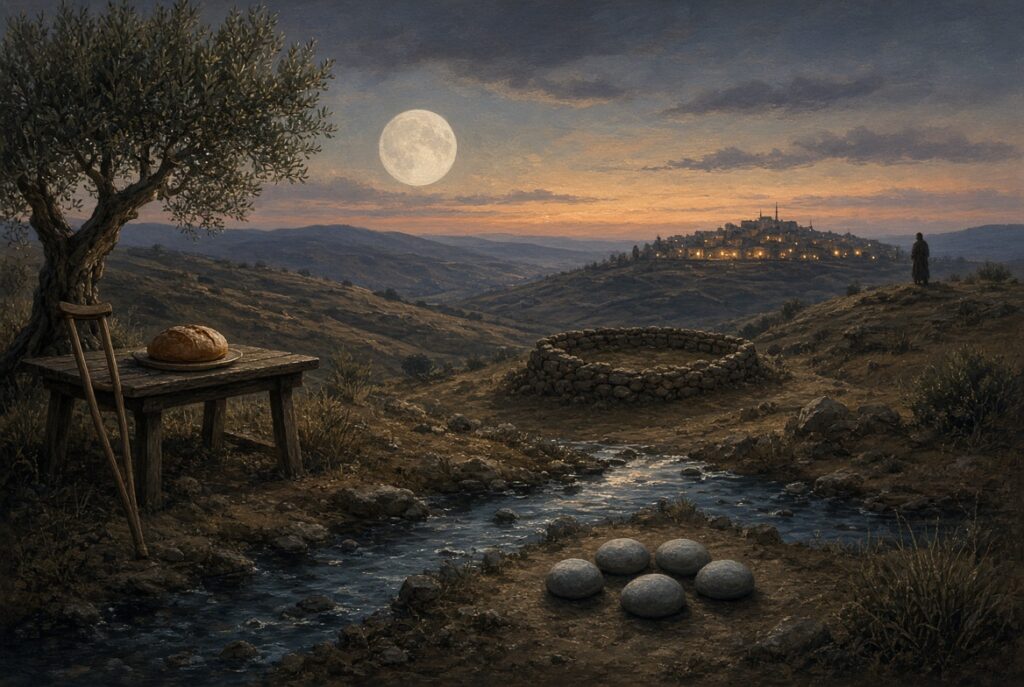
Five stones in the brook, none of them thrown. The moon is larger at the rim and unchanged in the measure. The oil is already on the shepherd. The child is not the cost.
The giant hangs there, larger, like the moon. The size is still the size. The reach, the reach. A question swells against the rim, and asks who fell, and who was only in the way.
Five stones in the bag, and the brook still cold. He did not need the giant to know the count. Smooth from the water, chosen, not yet thrown. The last light walked by fives. The light before it kept the count where the foot does not look. This one takes the house. Samuel, not the giant. The giant remains, as the moon remains, larger at the rim and unchanged in the measure. What follows is the man who pointed past him.
A soldier heard the questions first where the giant stood, and looked, and for the first time saw the one who had already named the boy. Not the sling. The anointer. First love has a face, and the face was Samuel. Moses carried a people like a child for forty years, arms held up on the hill until the hands were heavy and another man had to hold them there (Exodus 17:11–12). He struck the rock when he had been told to speak, and struck it twice, and the water came, and the land was kept from his feet (Numbers 20:7–12). G-d lifted him anyway, to the top of Pisgah, and showed him the promise: the fruit, the country, Gilead as far as the sea (Deuteronomy 34:1–4). He saw it. He did not cross. The seeing was the honor. This page is that kind of lifting. Not a claim to wear Samuel. A hill where the arms can stay up long enough to look at him.
The vow, before the boy could answer Hannah asked for a child and priced him in the asking. Given to the L-rd all the days of his life, and no razor on his head (1 Samuel 1:11). She brought him when the boy was weaned, and lent him to the L-rd (1 Samuel 1:27–28). The Masoretic text stops at the razor. The Greek adds the cup. Either reading, the dedication is the mother’s vow, kept. He grows in favor with the L-rd and with men while Eli’s sons do not (1 Samuel 2:26). The L-rd lets none of his words fall to the ground (1 Samuel 3:19). Later the prophets set him with Moses, an intercessor G-d names (Jeremiah 15:1; Psalm 99:6).
Dedicated. Not destined. The proverb will say, train up a child in the way he should go, and when he is old he will not depart from it (Proverbs 22:6). That is a groove, not a chain. Deuteronomy puts the words on the parent’s heart first, then on the walk, the sitting down, the rising (Deuteronomy 6:6–7). Ephesians says bring them up in the discipline and instruction of the L-rd, and do not provoke them (Ephesians 6:4). Formation is commanded. The result is not a warrant, and it is not a mark on the young. The ox that turns at the end of the furrow does not mean the field was empty. A child was lost in it, buried where the plow crossed, the share going out and the share coming back over the same small ground. The turning did not make the loss holy. It marked the place. What was buried is what the later table is for.
The king who failed, and the king on the block Saul was anointed by this same Samuel, and began in the signs, and did not stay (1 Samuel 10; 15). He spared Agag. He spared the best of the spoil. He built a monument to himself at Carmel. Samuel heard the bleating, and the L-rd had already torn the kingdom away.
Here the picture has to be kept in the verse, or it lies. Samuel did not lay Saul on a butcher’s block. Saul failed, and the king Saul would not finish was brought to the block. Agag came cheerfully, saying, surely the bitterness of death is past. Samuel said, as your sword has made women childless, so shall your mother be childless among women. And Samuel hacked Agag in pieces before the L-rd at Gilgal (1 Samuel 15:32–33). The failed king of Israel stands beside the block. The king of Amalek is the one taken apart. The mantle is not yet on David. The oil is waiting.
Every reading that puts Saul’s body under the knife has left the chapter. Every reading that spares Agag has left it with Saul.
Not every Saul is Saul The name walks out of the book and into another road. A man breathing threats goes toward Damascus and cannot see (Acts 9:1–9). Scales. A hand. A new name waiting, though the old name is still in the mouth of the churches he will suffer for. He did not lose the crown. He lost the day, and had to be led.
Some readers never leave the glass. They come for a reflection and stay for the likeness, and the chapter is only the light on the face. The mirror is faithful. It is not the call. Samuel’s question to Israel was not “do you see yourself.” It was “whose ox have I taken,” asked in front of the L-rd and the anointed, with restitution offered if a hand went up (1 Samuel 12:1–5). No hand went up. The L-rd was witness. That public clearing does not make him sinless. It makes the charge, on that day, unanswered. G-d never records a sentence on Samuel the way he records one on Eli, on Saul, on David. No fault is said of him in the square. The blind spot is the house.
Turn the leaves back, as the last light turned them, before the lamps were hung. Under the page the ground has been opened. A root plucked up looks, for a season, like an end. Jesse’s root is that kind of opening: a shoot from the stump, a branch from the roots, the one who stands as a signal (Isaiah 11:1, 10). Samuel is not the branch. He is the hand that pointed at the stump while a king still wore the crown. The leaves turn. What was buried is not gone. The charge that found nothing in his hand is not a boast. It is the ground left clear enough for the root to be seen.
The last light’s own turn is still there: “Turn back the leaves. Before the lamps were hung, there was a light, and all of it was good.” This page turns them again, and finds Samuel standing over the opened ground, not wearing the branch.
Beersheba, then Bethlehem When he was old he made Joel and Abijah judges in Beersheba. They turned aside after gain, took bribes, and perverted justice (1 Samuel 8:1–3). The elders used the sons as the door and asked for a king like the nations. Samuel prayed, and the word came back: they have not rejected you, they have rejected me from being king (1 Samuel 8:7). The appointment may have been the fault. Judges had not been a heritage. Gideon had already refused a dynasty (Judges 8:22–23). Or the text may blame the sons and leave the father standing in the square, cleared of the ox and the bribe, unable to see his own south. Both readings leave the same opening. The blind spot is how Saul comes in.
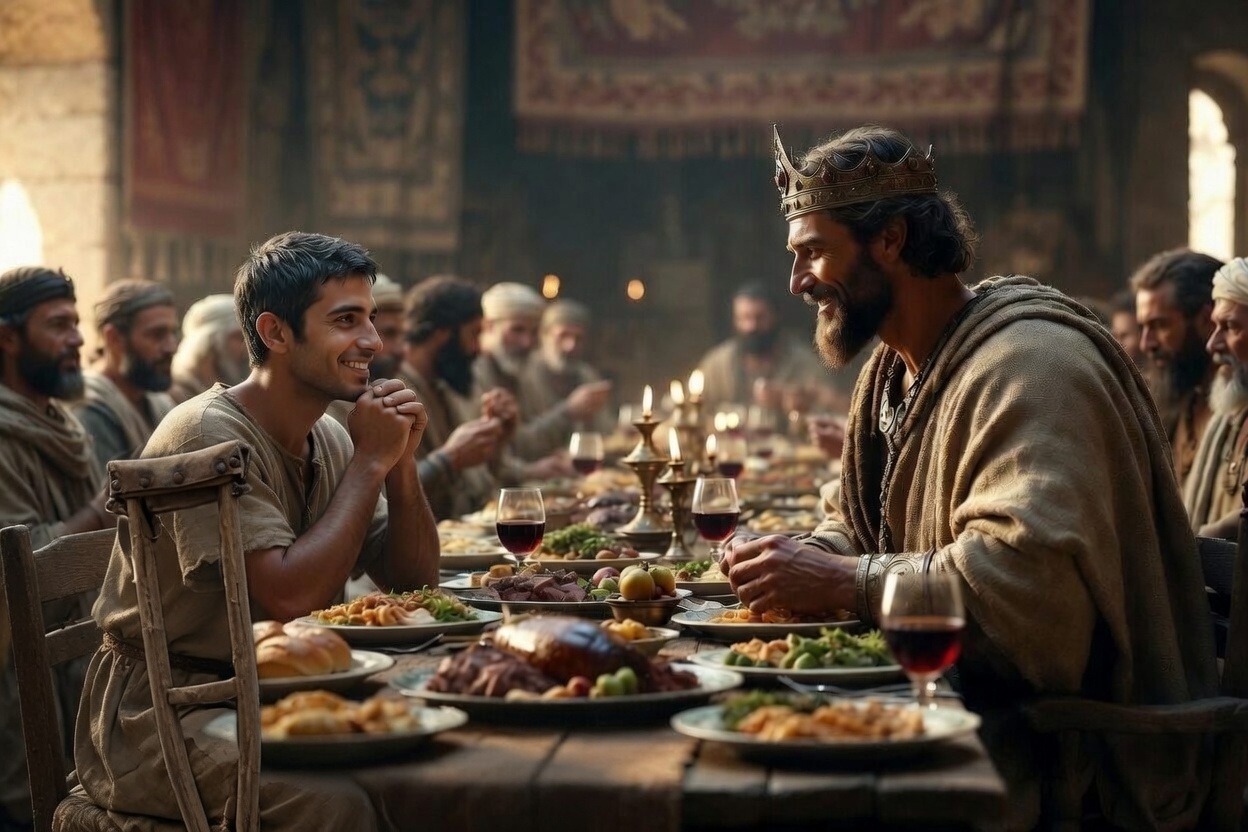
And still Samuel is the one who points. He anoints David in the midst of his brothers while Saul wears the crown (1 Samuel 16:1–13). The house begins there. Not at the giant. The giant comes after, a swell at the rim, the size unchanged. The shepherd is already named. Five stones wait in a bag that has not been opened. The oil is already on the head.
Whom shall I send, and who will go for us? Here am I. Send me.
The singular and the plural sit in one mouth (Isaiah 6:8). Isaiah is not Samuel. The coal is not the razor. But the shape is the same shape. A man of unclean lips, among a people of unclean lips, answered, and became a mouthpiece others would not see and would not hear (Isaiah 6:5–10). Samuel heard his name in the dark and thought it was the priest. Isaiah heard a question with two numbers in it and answered in the singular. Neither of them invented the sending.
The furrorw’s end The line goes out to the dump, and the round is chambered, and a man says send it, and the ghost departed. The ghost departed, and send it, and the round chambered, and the dump is where the line comes back.
A shot takes breath from both parties. The one who fires is not unpaid. Hebrews does not offer a reset: it is appointed for man to die once, and after that the judgment (Hebrews 9:27). Nephesh is not a rank. The swarm is nephesh, and the man is nephesh when the breath is in him (Genesis 1:20; 2:7). What marks him is the word he can answer. The cunning in the garden is another word, arum, the serpent more subtle than any beast of the field (Genesis 3:1). Subtle is the test. It is not a higher soul, and it is not a young hostile. Dedicated is still not destined. The furrow already told it: the field was not empty, and the turning did not make the loss holy.
No Pasture Lo-debar has no pasture. A nurse runs from the news of Gilboa and drops a five-year-old, and he is lame in both feet (2 Samuel 4:4). The house of Saul is cut down, and one grandson lives in the place of no pasture, and calls himself a dead dog when the king asks if anyone remains to whom he may show kindness for Jonathan’s sake (2 Samuel 9:1–8). David restores the land and sets him at the table like a king’s son (2 Samuel 9:11–13). Ziba lies. Mephibosheth comes unkempt from mourning and says, let him take it all, so long as my lord the king has come home safe (2 Samuel 19:24–30).
A fallen house. A dropped child. A table in the presence of enemies, which is Psalm 23 lived inside the house Samuel pointed toward, and not yet a later name laid over David. The shepherd-king keeps a covenant the dead friend made him make. The lame heir seeks the presence, not the increase.
The table, read forward Goodness and mercy follow the man who had been called a dog. The child in Isaiah’s oracle plays over the cobra’s hole, and the weaned child puts a hand on the adder’s den, and the next verse shuts the gate: they shall not hurt or destroy on my holy mountain (Isaiah 11:6–9). The longer ending of Mark says they will take up serpents and not be hurt (Mark 16:18). The shorter ending stops at the women fleeing, saying nothing (Mark 16:8). Neither ending spends the child. Before any of these, a staff hit the ground and was a serpent, and the man who threw it ran. Moses was afraid to pick it up. He was told to take it by the tail. He did, and it was a staff again (Exodus 4:2–4). David’s hand found another thing that had been in the water. A smooth stone, chosen, not yet the giant’s errand (1 Samuel 17:40). The staff was feared and taken up. The stone was smooth and sent. Thanks for sending me. Send it. The word is the same word Isaiah answered, here am I, send me (Isaiah 6:8), and the same sending Samuel had already done when he poured the oil. The bronze serpent is the other text. The bite was already killing. Moses lifted the bronze, and whoever looked, lived (Numbers 21:4–9). Not every look lives. Lot’s wife looked back, and she was a pillar of salt (Genesis 19:26). One look took the healing. One look took the city into the body and left her standing. The Son of Man, lifted, is set beside the look that lives (John 3:14). Look is not license. The child is a child. The serpent is a serpent. Non-combatants do not make the front of the page. No innocent life is the cost of getting the king home.
The hole is where the danger lived, and it does not get the hand. A child was lost, buried in the cross plow. The share went out. The share came back. And the child was the ground they had forgotten. The table is where the dog sat and was called a son. The oil was on the shepherd before the giant swelled. A staff became a serpent and was a staff again. A smooth stone. Thanks for sending me. Send it. Five stones, and the hand still open. The moon did not grow. It only neared the rim.
What the square already said Samuel walked before them from his youth to that day. He had made the king they asked for. He put his sons in their sight and did not hide them. He asked for a witness against his own hand, and the people, who had grounds against the sons, had none against him. The L-rd is witness, they said (1 Samuel 12:2–5). After that he did not retire into the glass. He warned them that the king would not save them from the rejection already made, and that if they did evil, they and their king would be swept away (1 Samuel 12:25).
The questions hang where the moon hangs. Who took the ox. Who spared the king. Who dropped the child. Who sits at the table. Who will go for us. They are chapter and verse, not a mood. He has been here: the weight is different, and some images were not invented, and the line is not a release. Today, he says, you will be with me there: the lamps put by, the measure held, the distance not a swelling. Five stones still in the bag. Samuel has pointed. The house is the house. The giant is still the moon.
And at the close, the school of fish, lifted up in baskets. Not a throne-storm restaged. The nets came up heavy, and the fragments filled the baskets, and what was lifted was for the feeding, not for show (Luke 5:6–7; John 6:9–13). The first word this school set down was a baton, and a storm, and a seer who could not pierce the veil and still said the end of the ages burns. The baton passes. The fire was not invented here. He said he came to cast it, and that he came to divide, and he wished it were already kindled (Luke 12:49–53). It passed through a boy in a linen ephod who answered in the dark, and through a man whose arms grew heavy on a hill, and through a soldier who came for a giant and found Samuel standing behind the oil. Honor is not a louder voice. Honor is the hands held up until the promise can be seen. The fruit is on the far side. He saw it. The article, if it sings, sings there.
A life reads a text, and the text reads the life back. The soldier who stopped at the giant is the one turning these leaves, and the leaves return him to the first look, behind the sling, where Samuel was already standing. The whole is in the part he first heard. The part is in the whole he has carried since. That is the circle. It does not coil around him. It lengthens, and turns, and comes back on itself, and does not take the hand. The child will not be hurt. It closes on the one he saw.