Thorn in the Double Mind: How Samekh’s Piercing Support Exposes the Half-Hearted - Psalm 119:112-120
In this Samekh stanza of Psalm 119, the psalmist stands resolute as a lamp in deepening shadows. His heart is inclined with unwavering purpose toward the statutes of G-d “forever, to the end.” He does not negotiate with compromise. He hates division with a holy fire while loving the law that becomes his shield and hiding place. Here the ancient letter Samekh—pictographically a sharp thorn—emerges as both support and piercing exposure. It upholds the single-minded while laying bare the instability of the double-minded.
Paleo Hebrew as the original pictographic script used to write the Hebrew Bible (Old Testament) prior to the Babylonian Exile, which was later replaced by the square Aramaic script.
Psalm 119:112-120 ESV I incline my heart to perform your statutes forever, to the end. Samekh I hate the double-minded, but I love your law. You are my hiding place and my shield; I hope in your word. Depart from me, you evildoers, that I may keep the commandments of my God. Uphold me according to your promise, that I may live, and let me not be put to shame in my hope! Hold me up, that I may be safe and have regard for your statutes continually! You spurn all who go astray from your statutes, for their cunning is in vain. All the wicked of the earth you discard like dross; therefore I love your testimonies. My flesh trembles for fear of you, and I am afraid of your judgments.
The Ancient Thorn That Divides the Heart
The Hebrew term se’ephim (סֵעֲפִים) in verse 113, often rendered “double-minded” or “half-hearted,” derives from the root sa’aph (סָעַף), connoting division, lopping off, or severance. In the concrete thought-world of ancient Hebrew, this is no abstract psychological state but a visceral image of a heart cut in two—loyalty severed at the root.
Paleo-Hebrew Pictographic Insight (drawing on the concrete, image-rich script of the pre-exilic period):
Samekh (ס): Pictured as a thorn or piercing stake—sharp, clinging, protective. It speaks of support that grips firmly (as thorns enclose a flock) yet also of pain that exposes and pricks. Ayin (ע): The eye—seeing, perceiving, often with the nuance of focused attention or surveillance. Peh (פ): The mouth—speech, declaration, the outflow of the inner reality.
Combined, sa’eph evokes a thorn-like division that sees two ways and speaks from two sides: the classic posture of spiritual duplicity. This is not mere indecision; it is a lopped-off devotion that grows outward in worldly directions rather than upward toward the singular Source of life. In modern terms, it aligns with the “double-souled” (dipsuchos) person of James 1:8—unstable in all his ways.
Together, the pictorial meaning in Sa’eph can be understood as a “thorn” (Samekh) or sharp division that “sees” (Ayin) two ways and “speaks” (Peh) from two sides, resulting in a divided heart.
Paleo Hebrew Samekh vs Modern Hebrew Samekh Evolution to “Double-Minded” In modern Hebrew, this concept translates to being split-minded or “half-hearted” (סֵעֲפִים – se’ephim). The transition to “double-minded” occurred as follows:
Original Imagery: The root Sa’aph means “to lop off” or cut, akin to topping a tree to make it grow outwardly rather than upward, symbolizing a lack of proper root and spiritual focus.
Biblical Usage: In Psalm 119:113, se’ephim refers to those who are divided in loyalty—trying to follow G-d while also loving the ways of the world. It signifies a spiritual conflict or inner contradiction.
Modern Understanding: It denotes someone who is “half-hearted,” a skeptic, or a “divided” person. In the context of James 1:8, it is a “two-souled” (dipsuchos) individual who is unstable, lacking conviction and direction.
Key Differences
Paleo/Biblical View: Emphasizes the action of cutting or dividing one’s devotion (a “divided” heart).
Modern View: Emphasizes the inner state of having two conflicting opinions, thoughts, or desires simultaneously (a “double” mind).
In essence, a double-minded person in this context is “separated” from single-minded devotion, resulting in internal conflict.
The term for “double-minded” (se’ephim) in Psalm 119:113 is rooted in the Hebrew word connected to division and half-heartedness. In Paleo-Hebrew Samekh (ס) originates as a picture of a thorn or piercing object—symbolizing something that grabs hold, supports like a shield, yet also pierces and exposes.
This thorn imagery reaches its deepest biblical significance when we connect it to the Fall and its ultimate resolution in Christ.
Genesis 3:18, “thorns and thistles it shall bring forth for you; and you shall eat the plants of the field.” John 3:18 “Whoever believes in him is not condemned, but whoever does not believe is condemned already, because he has not believed in the name of the only Son of God.”
From the Thorns of the Curse to the Thorn of the Cross At first glance these verses seem distant—one from the curse pronounced after Adam’s disobedience, the other from Jesus’ conversation with Nicodemus. Yet they form a powerful theological thread that runs straight through the theme of Samekh.
Genesis 3:18 reveals the immediate, tangible consequence of sin: the ground itself is cursed and now produces thorns and thistles. What was once effortless abundance in Eden becomes painful toil, frustration, and futility. Thorns stand as enduring symbols of the broken creation and the division that entered the human heart.
John 3:18 reveals the deeper spiritual reality of that same curse: humanity stands “condemned already” by default. The double-minded condition introduced in the Garden—trying to serve two masters, seeing and speaking from two sides—leaves the heart fractured and under judgment.
The connection is profound: Thorns as the emblem of the curse (Genesis 3:18) become a recurring biblical motif. At the crucifixion, soldiers pressed a crown of thorns onto Jesus’ head. The second Adam willingly wore the very symbol of the curse unleashed by the first Adam.
What began as thorns in the field (judgment on creation) culminates in thorns on the brow of the Savior (substitutionary atonement).
Genesis 3:18 diagnoses the curse. John 3:18 proclaims the cure: faith in the Son removes condemnation.
Professor Wolfson’s Economics 101: Meanwhile the cost of tuition rings up the tab. There sits the wolf at the chalkboard, chalk dust flying like shredded credibility, scribbling equations that somehow always add up to “more hours = more money.” Time is the real magic trick—equating to itself, yet never directly observable by science. We can’t bottle it, weigh it, or run it through a spectrometer, but we sure as hell meter it out in 50-minute increments. Every tick of the clock isn’t just paying for the fruit of the teacher’s living; it’s the quiet currency of macro-evolution too. Millions of years of “deep time” waved like a wand to solve the problem of missing transitions, unobserved mechanisms, and inconvenient gaps—non-refundable, payable in advance, just like that shredded reputation. The tuition bell rings again. The wolf keeps writing. The tab keeps growing. And somehow, time—the invisible magician—makes it all disappear into the syllabus.
Samekh’s thorn, therefore, does more than expose the double-minded. It points us to the only place where the divided heart can find wholeness— at the cross, where the piercing support of Christ upholds the single-minded and removes the condemnation that once pierced us.
The Serpent’s Cunning and the Fruit of Knowledge This ancient pattern of division traces directly back to the Garden. The serpent—more cunning (arum) than any other beast of the field—whispered a deadly half-truth to Eve.
Genesis 3:5: “For God knows that when you eat of it your eyes will be opened, and you will be like God, knowing good and evil.”
What appealed to Eve (and then to Adam) was not merely the fruit’s appearance but the promise of autonomous discernment. The tree of knowledge of “good and evil” carried both the lure of forbidden insight (such as sorcery or occult wisdom—fruit of the knowledge of evil alone; cf. Daniel 2; 2:10-11; Proverbs 3:5; 1 Corinthians 2:14; 2 Peter 3:16) and the deeper temptation to become one’s own moral standard bearer apart from G-d (man knows best). The serpent’s cunning offered the illusion that humanity could discern right and wrong independently of the Creator’s revealed will (worldly wisdom). The result was a fractured heart — eyes opened to shame, loyalty divided, and fellowship broken.
Application: Credentialed Wolves and the Independence of Truth Today the same temptation appears dressed in academic robes. Logical fallacies — particularly appeals to authority and popularity — suggest that without university credentials, peer approval, or institutional backing, truth somehow loses its validity. Tuition clocks tick by the thousands per hour while worldly values are presented as enlightened wisdom. Yet truth is truth. It does not bow to credentials, majority opinion, popularity, or democracy (man-y knows best). As the psalmist discards the cunning of the wayward like dross (v. 118), the single-minded believer clings to G-d’s Word as the ultimate standard. The Lamp still exposes darkness — regardless of who speaks it.

 Samekh—pictographically a sharp thorn—emerges as both support and piercing exposure. It upholds the single-minded while laying bare the instability of the double-minded.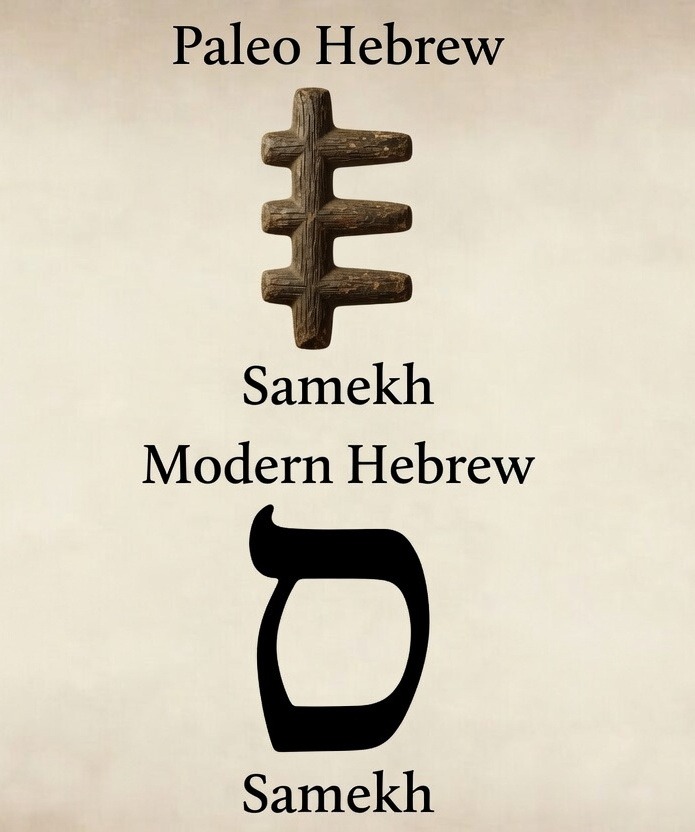

 (ס): Pictured as a thorn or piercing stake—sharp, clinging, protective. It speaks of support that grips firmly (as thorns enclose a flock) yet also of pain that exposes and pricks.
 (ע): The eye—seeing, perceiving, often with the nuance of focused attention or surveillance.
 (פ): The mouth—speech, declaration, the outflow of the inner reality.