Walls of Water and the Breath of G-d: Typology from the Older Serving the Younger to the Red Sea Crossing and the Greater Exodus in Christ
Remember that the L-rd delivered His people with a mighty hand and an outstretched arm. The same G-d who drove back the sea by His Spirit now delivers Jew and Gentile from the bondage of sin through the greater Moses.
The Pattern Established: The Older Shall Serve the Younger From the earliest pages of Scripture the L-rd refuses the natural claim of the firstborn. Cain, the elder, should have protected and served Abel; instead he murdered him. The blood of the younger cried from the ground, and G-d’s justice answered. Ishmael, the son according to the flesh, was set aside for Isaac, the son of promise. Esau, the hunter and firstborn, sold his birthright and later found no place of repentance, though he sought it with tears. The divine oracle had already spoken over Rebekah’s womb: “Two nations are in your womb… the older shall serve the younger” (Genesis 25:23).
Malachi closes the Old Testament prophetic corpus by drawing the line with finality: “‘I have loved Jacob but Esau I have hated’” (Malachi 1:2–3). The covenant head is not determined by chronological priority, natural strength, or human preference. G-d Himself decides the covenant head. The pattern is consistent, sovereign, and typological.
Typology, Types, and Shadows—Not Allegory This very pattern—the older serving the younger—is the historical correspondence under divine intention that trains us how to read typology. A type is a real person, event, or institution that G-d designed to prefigure a greater antitype. Shadows point forward to the substance (Colossians 2:17; Hebrews 10:1). Allegory, by contrast, often dissolves the historical sense in favor of inventive spiritual meanings controlled chiefly by the interpreter’s imagination.
Typology does not erase the concrete history; it reads that history as preparatory and escalatory. The older-shall-serve-the-younger motif is therefore not a free allegory we impose; it is the dry land G-d Himself laid down. It is the bridge that carries us from the patriarchal narratives into the greater deliverance at the sea. Just as the younger was chosen over the older according to the flesh, so the true Israel according to promise is chosen over the Israel according to the flesh. That same sovereign pattern reaches its next concrete stage when G-d drives back the waters and makes a path of dry ground—another historical correspondence that Paul later treats as baptismal typology: “our fathers were all under the cloud, and all passed through the sea, and all were baptized into Moses in the cloud and in the sea” (1 Corinthians 10:1–2). Peter, speaking of the flood waters that carried the ark, likewise sees the water as the instrument of salvation that finds its antitype in baptism (1 Peter 3:20–21). The dry land between the walls is therefore not merely geography; it is the typological bridge from the older-serving-the-younger pattern into the greater Exodus accomplished by the greater Moses.
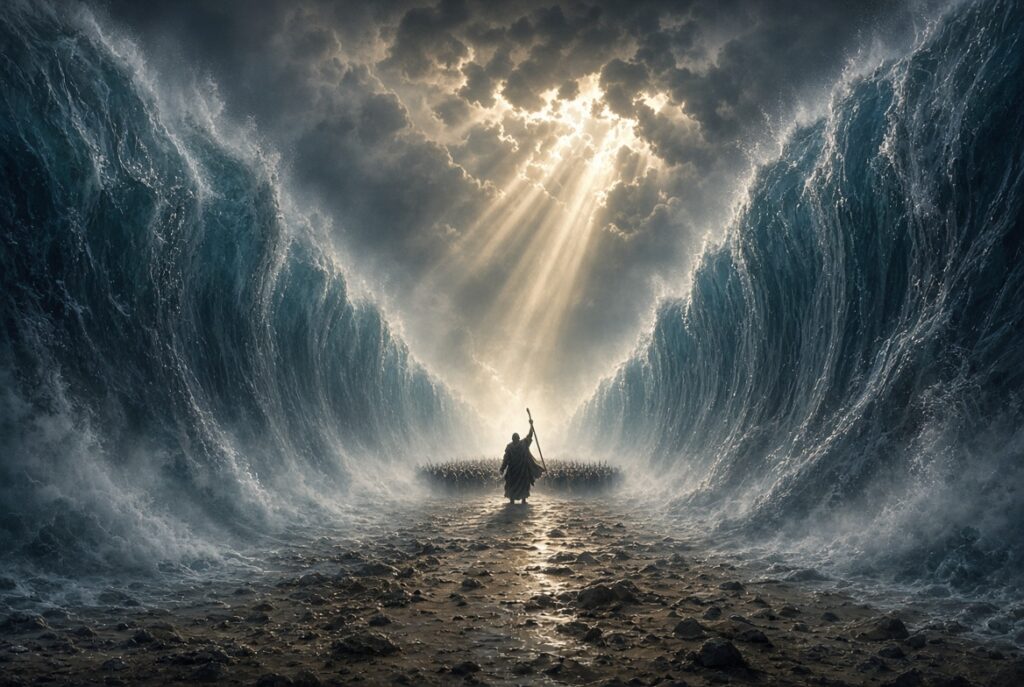
The East Wind and the Hovering Spirit At the Red Sea the L-rd “drove the sea back by a strong east wind all night and made the sea dry land, and the waters were divided” (Exodus 14:21). The same רוּחַ Hebrew word ruach—wind, breath, Spirit—that describes the east wind is the רוּחַ הַקֹּדֶשׁ (Ruach HaKodesh) ruach of G-d that hovered over the face of the dark waters at the beginning (Genesis 1:2). The Spirit who was the active agent in the six days of creation is the same Spirit who, under the command of the Father, parts the sea. Creation and redemption are not parallel tracks; they are the work of the same Triune G-d.
Thomas Jefferson, the deist, is infamous for taking a razor to the Gospels and blacking out or excising every supernatural verse that offended his Enlightenment rationalism. The Jefferson Bible retains moral maxims while amputating the miracles, the resurrection, and the Spirit’s power. Scripture will not permit such surgery. The east wind is not a happy coincidence of meteorology. It is the same sovereign ruach that later regenerates dead hearts.
Jesus Himself makes the connection explicit: “The wind blows where it wishes, and you hear its sound, but you do not know where it comes from or where it goes. So it is with everyone who is born of the Spirit” (John 3:8). The supernatural division of the sea anticipates the supernatural work of regeneration. No one commands the Spirit any more than Israel commanded the east wind.
Moses and the Greater Moses Jesus repeatedly anchors His identity in Moses. “If you believed Moses, you would believe me; for he wrote of me” (John 5:46). On the Emmaus road He began with Moses and all the Prophets and interpreted the things concerning Himself (Luke 24:27). After the resurrection He opened the minds of the disciples to understand the Scriptures, saying that everything written about Him in the Law of Moses and the Prophets and the Psalms must be fulfilled (Luke 24:44). The bronze serpent lifted up in the wilderness (Numbers 21) becomes the explicit type of the Son of Man lifted up (John 3:14–15). Moses was the mediator of the Sinai covenant; Christ is the mediator of a better covenant. Moses delivered a people from political bondage; Christ delivers a people from the bondage of sin.
The message is deliberately repetitive because Scripture itself is repetitive: G-d delivered Israel from Egypt with a mighty hand and an outstretched arm. Jesus delivers not only the unfaithful among the Jews but expands the deliverance to the Gentiles, freeing them from the dominion of sin and death. The first Exodus was concrete—feet on dry ground between walls of water. The greater Exodus is both already accomplished and not yet fully consummated: the hope that heaven and earth shall be one, as the Son taught us to pray, “Your will be done, on earth as it is in heaven.”
The Trinity in Creation and Redemption The orthodox distinction must be kept clear. Ontologically the three Persons are co-equal, co-eternal, and of one essence. Economically there is an ordered working: the Father sends, the Son is sent, the Spirit proceeds and applies.
In Genesis 1 the Father speaks; the Spirit is the active agent hovering over the face of the deep; the eternal Son is the perfect Image through whom and for whom all things were made. That same ordered working appears again at the Red Sea. The ruach of G-d that once hovered over the dark, formless waters now becomes the strong east wind that drives the sea back, divides the waters, and raises the dry land—exactly as the Spirit once brought order out of chaos and caused the dry land to appear on the third day. No one can honestly claim these are different gods. The G-d who hovered over the primordial deep is the same G-d who hovered over the waters of the sea and made a path for His people. The Spirit who was the active agent in the six days of creation is the same Spirit who, under the command of the Father and for the sake of the Son, parts the sea. Creation and redemption are the continuous work of the one Triune G-d of Israel.
This is the same Spirit who later overshadowed Mary and knitted the flesh of the eternal Son in the womb (Luke 1:35; cf. the language of Psalm 139:13 and Jeremiah 1:5). The Spirit who once formed dry land from the deep and a path through the sea is the Spirit who formed the human nature of the Redeemer Himself. From creation, through the first Exodus, to the incarnation, it is one continuous work of the same Spirit.
Jesus repeatedly claimed He was sent to do the will of the Father (John 5:30; 6:38). In Gethsemane, when the weakness of the assumed human nature pressed upon Him, He prayed, “Not my will, but yours, be done.” The Persons are distinct enough to commune with one another in love; they are not distinct enough to oppose one another’s will. There is no internal conflict in the G-dhead. The same ordered harmony that hovered over the dark waters, drove the east wind, raised the dry land, and formed the body of the Son is the harmony that accomplished the greater deliverance at the cross and empty tomb.
At the Threshold of the Split Sea Imagine a wide landscape resolution of the Red Sea at the moment of division. Towering walls of water stand on either side, mist rising from the seabed. On the far end, still approaching the path between the walls, a shadowy figure—Moses—stands with staff raised, the people not yet having crossed. The deliverance under Moses was concrete: real water, real wind, real dry ground under real feet. The deliverance accomplished by Jesus is greater still, yet in this age largely abstract to the senses—its full visibility reserved for the day when heaven and earth are one.