Some believe it does matter who baptizes. While others believe it does not matter. Let’s examine two verses which might help answer this question:
John 3:22 After these things came Jesus and his disciples into the land of Judaea; and there he tarried with them, and baptized.
Seems the Baptism of Jesus was done by himself. However, in the following chapter:
John 4:1-3 When therefore the Lord knew how the Pharisees had heard that Jesus made and baptized more disciples than John, (Though Jesus himself baptized not, but his disciples,) He left Judaea, and departed again into Galilee.
So does it matter whether Jesus was baptizing or his disciples? What if Judas Iscariot baptized? I believe the answer can be understood in the theology of Covenant Baptism. The sanctity of the ordinance of baptism does not depend upon the person baptizing, nor is there any power conferred from the person, and neither does the piety of the baptizer or the intention effect the efficacy of the sacrament of baptism, but rather is dependent upon the work of the Spirit and the word of institution. (Matthew 28:19-20)
Two good resources to examine in order to help understand Baptism from the perspective of Covenant theology:
Westminster Confession of faith XXVIII. Of Baptism:
I. Baptism is a sacrament of the New Testament, ordained by Jesus Christ,a not only for the solemn admission of the party baptized into the visible Church,b but also to be unto him a sign and seal of the covenant of grace,c of his ingrafting into Christ,d of regeneration,e of remission of sins,f and of his giving up unto God, through Jesus Christ, to walk in newness of life:g which sacrament is, by Christ’s own appointment, to be continued in his Church until the end of the world.h
a. Mat 28:19. • b. 1 Cor 12:13. • c. Rom 4:11 with Col 2:11-12. • d. Rom 6:5; Gal 3:27. • e. Titus 3:5. • f. Mark 1:4. • g. Rom 6:3-4. • h. Mat 28:19-20.
II. The outward element to be used in this sacrament is water, wherewith the party is to be baptized in the name of the Father, and of the Son, and of the Holy Ghost, by a minister of the gospel lawfully called thereunto.
a. Mat 3:11; 28:19-20; John 1:33.
III. Dipping of the person into the water is not necessary; but baptism is rightly administered by pouring or sprinkling water upon the person.a
a. Mark 7:4; Acts 2:41; 16:33; Heb 9:10, 19-22.
IV. Not only those that do actually profess faith in and obedience unto Christ,a but also the infants of one or both believing parents are to be baptized.b
a. Mark 16:15-16; Acts 8:37-38. • b. Gen 17:7, 9 with Gal 3:9, 14 and Col 2:11-12 and Acts 2:38-39 and Rom 4:11-12; Mat 28:19; Mark 10:13-16; Luke 18:15; 1 Cor 7:14.
V. Although it be a great sin to contemn or neglect this ordinance,a yet grace and salvation are not so inseparably annexed unto it, as that no person can be regenerated or saved without it,b or that all that are baptized are undoubtedly regenerated.c
a. Luke 7:30 with Exod 4:24-26. • b. Acts 10:2, 4, 22, 31, 45, 47; Rom 4:11. • c. Acts 8:13, 23.
VI. The efficacy of baptism is not tied to that moment of time wherein it is administered;a yet, notwithstanding, by the right use of this ordinance the grace promised is not only offered, but really exhibited and conferred by the Holy Ghost, to such (whether of age or infants) as that grace belongeth unto, according to the counsel of God’s own will, in his appointed time.b
a. John 3:5, 8. • b. Acts 2:38, 41; Gal 3:27; Eph 5:25-26; Titus 3:5.
VII. The sacrament of baptism is but once to be administered to any person.a
a. Titus 3:5.
United Reformed Church:
What the Lord has revealed to us in His Word about holy baptism can be summarized in this way:
First, baptism teaches that we and our children are conceived and born in sin. This means that we are by nature children of wrath and for that reason cannot be members of Christ’s kingdom unless we are born again. Baptism, whether by immersion or sprinkling, teaches that sin has made us so impure that we must undergo a cleansing which only God can accomplish. By this we are admonished to detest ourselves, humble ourselves before God, and turn to Him for our cleansing and salvation.
Second, baptism signifies and seals to us the washing away of our sins through Jesus Christ. For this reason, we are baptized into the name of the Father, the Son, and the Holy Spirit.
When we are baptized into the name of the Father, God the Father testifies and seals to us that He makes an eternal covenant of grace with us and adopts us as His children and heirs. Therefore, He promises to provide us with everything good and protect us from all evil or turn it to our profit.
When we are baptized into the name of the Son, God the Son seals to us that He washes us in His blood from all our sins. Christ unites us to Himself, so that we share in His death and resurrection. Through this union with Christ, we are freed from our sins and accounted righteous before God.
When we are baptized into the name of the Holy Spirit, God the Holy Spirit assures us by this holy sacrament that He will make His home within us and will sanctify us as members of Christ. He will impart to us what we have in Christ, namely, the washing away of our sins and the daily renewing of our lives. As a result of His work within us, we shall finally be presented without the stain of sin among the assembly of the elect in life eternal.
Third, the covenant of grace contains both promises and obligations. Having considered the promises, we now consider the obligations. Through baptism, God calls us and places us under obligation to live in new obedience to Him. This means that we must cling to this one God, Father, Son, and Holy Spirit. We must trust in Him and love Him with all our heart, soul, mind, and strength. We must renounce the sinful way of life. We must put to death our old nature and show by our lives that we belong to God. If we through weakness should fall into sin, we must not despair of God’s mercy, nor use our weakness as an excuse to keep sinning. Baptism is a seal and totally reliable witness that we have an eternal covenant with God.
Our children should not be excluded from baptism because of their inability to understand its meaning. Just as, without their knowledge, they share in Adam’s condemnation, so are they, without their knowledge, received to grace in Christ.
God’s gracious attitude toward us and our children is revealed in what He said to Abraham, the father of all believers: “And I will establish my covenant between me and you and your offspring after you throughout their generations for an everlasting covenant, to be God to you and to your offspring after you” (Gen. 17:7). The apostle Peter also testifies to this with these words: “For the promise is for you and for your children and for all who are far off, everyone whom the Lord our God calls to himself” (Acts 2:39). Therefore, God formerly commanded that children be circumcised as a seal of the covenant and of the righteousness that comes by faith. Christ also recognized that children are members of the covenant people when He embraced them, laid His hands on them, and blessed them (Mark 10:16). Since baptism has replaced circumcision as the sign and seal of the covenant (Col. 2:11–13), our children should be baptized as heirs of God’s kingdom and of His covenant.
Then what of the baptism done by John the Baptist? Or another denomination which rejects the Trinity (Oneness Pentecostals)? Should baptism be readministered? While rebaptism is another topic let’s examine Acts 19:6
And it came to pass, that, while Apollos was at Corinth, Paul having passed through the upper coasts came to Ephesus: and finding certain disciples, He said unto them, Have ye received the Holy Ghost since ye believed? And they said unto him, We have not so much as heard whether there be any Holy Ghost. And he said unto them, Unto what then were ye baptized? And they said, Unto John’s baptism. Then said Paul, John verily baptized with the baptism of repentance, saying unto the people, that they should believe on him which should come after him, that is, on Christ Jesus. When they heard this, they were baptized in the name of the Lord Jesus. And when Paul had laid his hands upon them, the Holy Ghost came on them; and they spake with tongues, and prophesied.
Some use Acts 19:1-6 to redefine and translate baptism to gifts of the Holy Spirit. And readminister water to rebaptize, clearly the sacrament of laying on of hands is not the same as the re-administration of water. In all the arguments I hear by rebaptizers the emphasis seemingly is placed on some fault of the person baptizing or the person being baptized as if the promise of G-d was somehow thwarted by character or ignorance. There are so many things to doubt in life, like whether or not the weather forecast for tomorrow will be correct.
Of interest:
The Diadache: This is how to baptize. Give public instruction on all these points, and then baptize in running water, ‘in the name of the Father and of the Son and of the Holy Spirit.’ If you do not have running water, baptize in some other. If you cannot in cold, then in warm. If you have neither, then pour water on the head three times ‘in the name of the Father, Son, and Holy Spirit.’ Before the baptism, moreover, the one who baptizes and the one being baptized must fast, and any others who can. And you must tell the one being baptized to fast for one or two days beforehand.
Concerning the mode of baptism running water should be used according to the Diadache, perhaps because running water is considered living water if contrasted to dead still water. Though the institution and mode of baptism is for another topic, that is, whether or not emersion is necessary or sprinkling etc., and if one or the other was not performed, the services of a rebaptizer become necessary to be efficacious (sarcasm), and no amount of Scripture will seemingly change the mind or edify the rebaptizer.
John 4:14 But whosoever drinketh of the water that I shall give him shall never thirst; but the water that I shall give him shall be in him a well of water springing up into everlasting life.
Soli Deo Gloria Wit
Notes:
Both Roman Catholics and Protestants outwardly appear to be paedo baptist baptizing young children. Roman Catholics believe in baptismal regeneration while Protestants do not. The Westminster Confession of Faith: V. Although it be a great sin to contemn or neglect this ordinance, yet grace and salvation are not so inseparably annexed unto it, as that no person can be regenerated or saved without it, or that all that are baptized are undoubtedly regenerated.
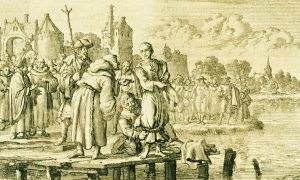
In the strict sense of the universal catholic term both Catholics and Protestants disagree with the rebaptizers. In history, Anabaptists were heavily persecuted by both Protestants and Roman Catholics civil magistrates during the 16th and 17th centuries. They were drowned and burned at the stake. At one time over 200 Anabaptists were drowned in a river while their executioners said, “let baptism save you.” Why convey doubt rather than faith?
Matthew 18:6 But whoso shall offend one of these little ones which believe in me, it were better for him that a millstone were hanged about his neck, and that he were drowned in the depth of the sea.
Consider,
1 Corinthians 1:13-15 Is Christ divided? was Paul crucified for you? or were ye baptized in the name of Paul? I thank God that I baptized none of you, but Crispus and Gaius; Lest any should say that I had baptized in mine own name.

 Some believe it does matter who baptizes. While others believe it does not matter. Let’s examine two verses which might help answer this question:
 In the strict sense of the universal catholic term both Catholics and Protestants disagree with the rebaptizers. In history, Anabaptists were heavily persecuted by both Protestants and Roman Catholics civil magistrates during the 16th and 17th centuries. They were drowned and burned at the stake. At one time over 200 Anabaptists were drowned in a river while their executioners said, “let baptism save you.” Why convey doubt rather than faith?
 In the strict sense of the universal catholic term both Catholics and Protestants disagree with the rebaptizers. In history, Anabaptists were heavily persecuted by both Protestants and Roman Catholics civil magistrates during the 16th and 17th centuries. They were drowned and burned at the stake. At one time over 200 Anabaptists were drowned in a river while their executioners said, “let baptism save you.” Why convey doubt rather than faith?